The “interpretation of the fragment” by Christophoros Marinos (source: elikagallery.com):
A few dozen metres from the sea of Indignados in Syntagma Square, where helmeted men often smash tiles and ledges with their hammers, producing lethal fragments of marble, an artist is working wooden surfaces with his small hatchet, creating a series of semi-abstract, fragmentary images. His quest is plainly a solitary one, though no more solitary than Captain Nemo’s undersea walk in a diving suit through the Strait of Gibraltar. His method is violent but justified, like felling a tree to ensure the survival of a tireless traveller, or carving a heart to testify to a teenager’s first stirrings of love.
On Pericleous Street, on the first floor of a neoclassical building, in a space somewhere between home, workshop and refuge, where makeshift boats, divers, flags, barrels, pipes, containers and portraits of familiar or invented animals gather, Nikos Sepetzoglou has spent the last few years building his own Nautilus. Often adopting codes found in nautical language, the artist creates paintings that, as he puts it, are “like models of objects, monuments and volumes”.[1] In fact, according to him, these are works that do not function on their own but as a whole, which may also explain why he groups them by size into XL, L, M and S.
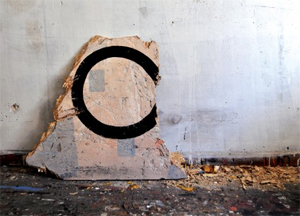
Among the “models” Sepetzoglou presents in this solo exhibition, one stands out: a medium-sized triangular wooden fragment with an unfinished black circle painted on one face. What one recognises in this enigmatic work depends on what one wants and hopes to find. After all, this particular “o”, which gives the exhibition its title, is a symbol open to many different interpretations. It could be a zero, nothing, the 15th letter of the alphabet, a hole, a passage, the facelessness of a face, a hint of the eye, the mouth that utters speech, the head that produces thought about the visible and the invisible, the void and the mythical Whole. “For me,” says Sepetzoglou, “it is the work most closely related to what I wanted to do; it is the most nothing work of all. It could have been the only one left from all the work. A circle is the most absolute shape you can make on something broken. It could be a letter from a word.”
Beyond being a trace of personal handwriting and a sign of (collective?) destruction, this remnant is also a reminder of the “usefulness of artists” and of “preserving the delicacy and instability of the senses”. Indeed, looking at Sepetzoglou’s emblematic fragment, and this holds for all the works in the series, one cannot help but consider a timely remark by Paul Valéry: “Most people see with the mind much more often than with the eyes. Instead of patches of colour, they recognise concepts. A whitish, tall, cube-shaped form, pierced by the reflections of windows, is automatically a house for them: the House! A complex idea, a harmony of abstract qualities. (…) They perceive more according to a dictionary than with their retina; they approach objects so badly, and know so vaguely the joys and pains of seeing them, that they invented beautiful landscapes. The rest they ignore.”[2]
It is clear, then, that Sepetzoglou’s fragment, which is not only the occasion for this section but also its deeper meaning, works as a metaphor for vision and the gaze, much like a painted target by Jasper Johns. Equally important here are the angle from which one views the work and the emotional intensity it conveys to the viewer. As the artist himself explains: “I’m interested in what remains of something that is destroyed, and the interest it can arouse afterwards. If something breaks in the middle, it sometimes creates a feeling much stronger than the whole. Then you look for the reasons why it happened. And although you don’t know how you view a fragmentary work, each time you propose it in a particular position. In the end, that position is determined by what you choose to narrate.”
There is no doubt that making Sepetzoglou’s works through destruction involves an intense release of energy and something liberating. His narratives coexist with wear and with restoration, the filling of a void. The harshness that characterises the way they are made and the roughness of the wooden surfaces are combined with a childlike quality in the figures depicted. “As for the construction,” says Sepetzoglou, “there are several ways of abstraction in this work, and one of them is layering. That too is a method of creating a fragment, one that involves correction, change and so on.” As for the subjects he depicts, or rather those that emerge from working the material, he points out: “Instinct has the first say in these works, and it also determines their iconography.”
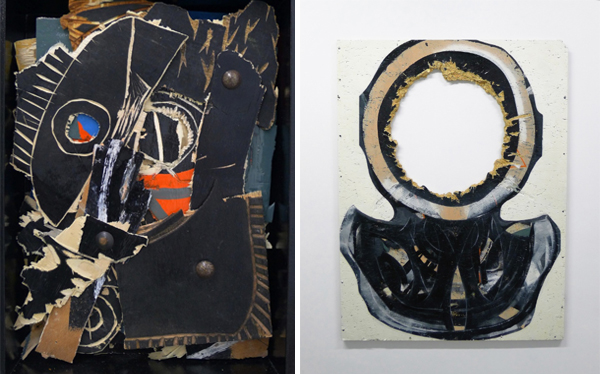
The key feature of Sepetzoglou’s fragmentary images is the union of the abstract and the concrete, along with the coincidence of painting and sculpture. In this respect, his works open up a strong dialogue with the history of art and, more specifically, with the expressionist painting of Asger Jorn and Cobra, with art brut, and with the personal mythology of Philip Guston, Paul Thek, Jean-Michel Basquiat and Alexis Akrithakis.
Equally illuminating, however, can be connections with individual works or artists who, at first sight, one would not expect to have any particular relation to Sepetzoglou’s work. For example, the painting of a diving helmet with a hole in it (a faceless “Varvara”!), which was created at the same time as the fragment with the black circle and complements it narratively, brings to mind René Magritte’s 1937 painting The Principle of Pleasure (Portrait of Edward James), in which the sitter’s head has been replaced by a halo of light.
On the other hand, the inescapable attraction the fragment with the “o” exerts on the artist is similar to the pull the mutilated Venus de Milo exerts on the art critic Peter Fuller, who tried to recreate her fragmentary image and proved, if not the best, then the boldest interpreter of her. Likewise, the presence of an absence, an element we find in the notches and gaping holes of Sepetzoglou’s works, strongly recalls “the realisation of a depiction of the presence of its absence”,[3] which, as Fuller notes, we grasp when we look at the paintings of Mark Rothko. This “nothing that beckons to you” and “invites you to annihilate yourself (within his paintings)” [4] is also characteristic of the fragment with the “o”. Indeed, according to Fuller’s psychoanalytic interpretation, the “manic activity” we find in Rothko’s biomorphic early works (which, in the case of the Greek artist, takes the form of hewing wood) is “a form of desperate defence against the underlying depression”.[5]
As the passage from Claude Lévi-Strauss’s The Savage Mind that Nikos Sepetzoglou chose to include in the press release for his exhibition suggests, his works are also “traces left behind by psychological or historical processes”.[6] Among the sculptural “vessels” he makes by sewing thin wood veneers together with string, one stands out: a white tube with various coloured directional marks painted on its side. Its shape recalls a broken water pipe. While Sepetzoglou was working on this piece, street fighting was under way outside his studio and fires were raging. Now that “the whole of Greece seems to have fallen into deep depression”, the artist decides to raise his wooden flag (“I have a diver down; keep well clear at slow speed”, he warns those around him), thus reminding us that a work of art also acts as a fire extinguisher, for internal as well as external seats of fire.
[1] This passage, and those that follow, come from a conversation between the author and the artist, held in his studio on 25 October 2011.[2] Paul Valéry, Introduction to the Method of Leonardo da Vinci, trans. Elissavet Varonou, Indiktos, Athens 2004, p. 22.
Opening hours:
Tuesday – Friday: 12:00 – 20:00
Saturday: 12:00 – 16:00
Exhibition dates: 3 November – 17 December 2011