At DASH®, everything we do is driven by a single vision: to help Greek families live better and to create the spaces they use every day at home, in the kitchen, the living room and the bedroom.
At the same time, we choose to take particular care of the environment and to contribute as far as we can to eco-friendly building. Some building materials, kitchen furniture among them, now carry a form of eco-label, which gives consumers some assurance of the product’s environmental credentials. Such labels may be awarded by national and intergovernmental bodies, or by independent non-governmental organisations.
Wood is the most important renewable raw material used as a building material. It requires relatively little processing, so the production process is relatively clean and consumes little energy. However, choosing wood as a building material should also take into account a number of further parameters that determine whether wood can truly be called an “eco-friendly” material. These are:
– The origin of the timber and the way the forests are managed.
– How the wood is treated, and in particular whether or not preservatives are used.
– The energy required for transport.
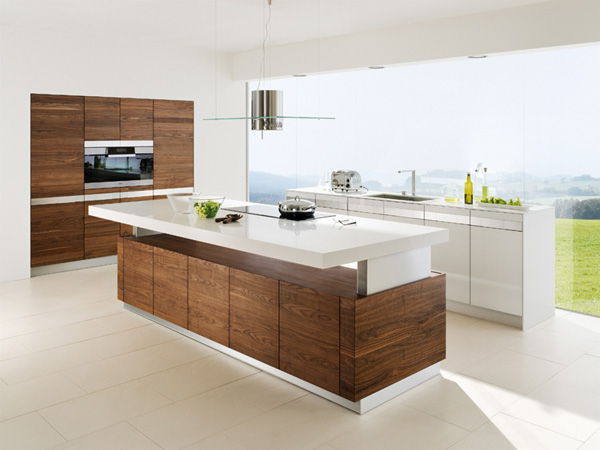
To build a complete kitchen, DASH® uses wood products such as particleboard (chipboard), fibreboard (MDF) and melamine, with almost zero formaldehyde emissions (E1-class particleboard and fibreboard). All the doors of DASH models are covered with various types of polyethylene film rather than PVC (polyvinyl chloride, commonly known as vinyl).
In addition, two of our kitchen ranges use eco-friendly lacquers to paint the doors.
Below, we provide some information about the types of timber most commonly used in furniture making.
Walnut
Origin: Austria, Slovenia and Hungary
Tree:
• Height of 20 to 25 metres
• Branch-free trunks are rare
• The tree has a large crown with many branches
Wood:
• Moderately hard wood
• Sapwood grey to yellowish; heartwood grey-brown, purple-brown to black-brown
• Moderate shrinkage
Special characteristics:
• Works well
• Highly decorative
• Colour variations are frequent
• A rare, high-value timber
• Used exclusively in furniture production
Beech
Origin: Germany, Austria
Tree:
• Height of 30 to 40 metres
• Smooth trunk; the crown begins high up
Wood:
• Hard, very elastic wood
• Reddish tone that darkens when steamed
• Pores lightly scattered, in large numbers
Special characteristics:
• Heavy wood
• Suited mainly to furniture
• High shrinkage
Alder
Origin: Hungary, Poland (wetlands such as meadows and river areas)
Tree:
• Slender trees, 20 to 33 metres tall
• Diameter of 30 to 60 centimetres
Wood:
• Medium-hard wood
• Reddish to yellowish with dark brown flecks
• Pores lightly scattered, almost non-existent
• Moderate shrinkage
Special characteristics:
• It is not over-exploited, because it grows quickly
• Takes surface treatments very well
• Frequent colour variations!
• In 1980 Team7 made the wood suitable for furniture production
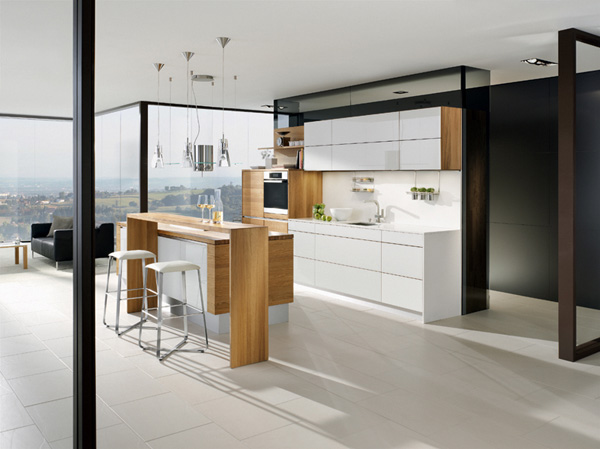
Heartwood beech
Origin: Germany, Austria
Tree:
• Height of 30 to 40 metres
• Smooth trunk; the crown begins high up
Wood:
• Hard wood (dense, minimally elastic)
• Reddish to chestnut-red, with a curved to pointed (peaked) figure and shading
• Optional shaping of the heartwood (interior)
Special characteristics:
• Colour differences, fine cracks, fused growths and small knots define the quality appearance of the wood
• The grain looks more authentic and alive thanks to the natural tones
• Decorative colours, widely used in furniture
Maple
Origin: Austria, Germany, Croatia and Romania
Tree:
• Height of up to 25 metres
• The trunk is branch-free up to 10 metres
Wood:
• Hard wood (dense and hard)
• Almost white in colour
• Scattered pores
Special characteristics:
• Works well
• Beautiful wavy texture (with figure)
• Yellows slightly (white vegetable oils bleach it)
• Suitable for furniture making
Oak
Origin: Germany, Austria, Hungary
Tree:
• Height of up to 35 metres
• The trunk is branch-free up to 10 metres
Wood:
• Hard wood
• The bark is grey; the interior is grey-brown to light red-brown
• Ring-porous hardwood
Special characteristics:
• Oak is highly decorative
• Drying must be done slowly, because oak tends to split and crack.
• Ideal for furniture making.
• Very durable
• The bark is not used in furniture making
Cherry
Origin: Austria, Hungary and Romania
Tree:
• Height of up to 20 metres
• A branch-free trunk is a rare occurrence
• Large crown with many branches
Wood:
• Medium-hard wood
• Darkens over time
• Semi-ring-porous wood
• If the wood has not been steamed, it shows many shades, from yellow through red to grey
Special characteristics:
• Works well
• Steaming produces a uniform reddish tone
• A rare, high-value timber
• Used exclusively in furniture making
Source: www.dash.com.gr