The Vezene restaurant stands behind the Hilton and is surrounded by an urban landscape that was the source of inspiration for both the décor and the lighting. In line with the owner’s brief, the interior is made of raw materials (sheet metal, leather and wood) that create harsh textures and exposed joints. Vezene captures the pulse of the city and presents it in a luxurious form. Within this casual luxury, the customer’s transition from the exterior to the interior happens “silently”.
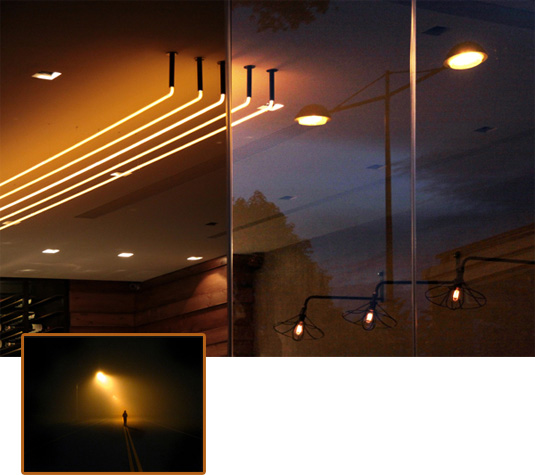
The lighting follows the same approach, bringing the atmosphere of the city at night into the interior. The sensation a pedestrian experiences in the evening, moving out of total darkness into the flood of light from orange sodium lamps, became the central idea, realised through architectural lighting and decorative lighting designed exclusively for the venue. No lighting element intrudes visually or obstructs the visitor’s view outside.
The prerequisite for the architectural lighting was complete control of the light, through fully recessed luminaires. They were chosen for their narrow beams, dimming, warm tones and adjustable heads.
The light had to be aimed fully at the tables and kept off the rest of the space, with the best possible colour rendering index and minimal heat emitted onto the tables. For these reasons, adjustable recessed plasterboard spotlights with narrow-beam dichroic lamps are used. Integrating them into the ceiling was essential, so that every functional element is contained within the shell and the necessary emphasis falls on the decorative luminaires.
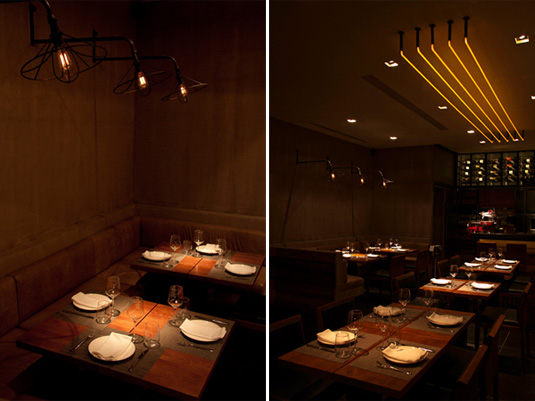
The decorative lighting consists of two custom-made pieces: the central pendant and the wall lights. Unlike the architectural luminaires, these blend into the surroundings of the venue through their iron construction and exposed lamps, following the philosophy of raw materials.
The light they produce is also “decorative”, since the spotlights meet the lighting requirements while imitating the way the wall light and the ceiling neon fixture would actually illuminate the space if they were not dimmed to the maximum.
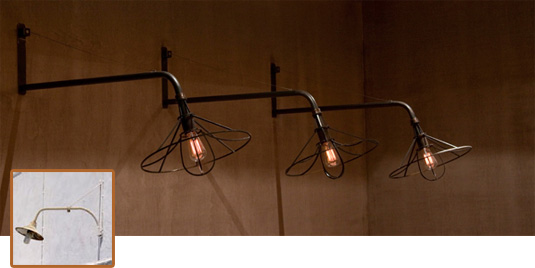
The wall lights represent the old Public Power Corporation (ΔΕΗ) street lamps that can still be found today on out-of-the-way streets in Athens and in the provinces. By stylising these fixtures and keeping their basic lines, we created a three-dimensional metal mesh that embraces a lamp with a distinctive linear filament. The heavily dimmed filament adds an extra orange tone, giving customers the illusion that they are dining beneath street lights.
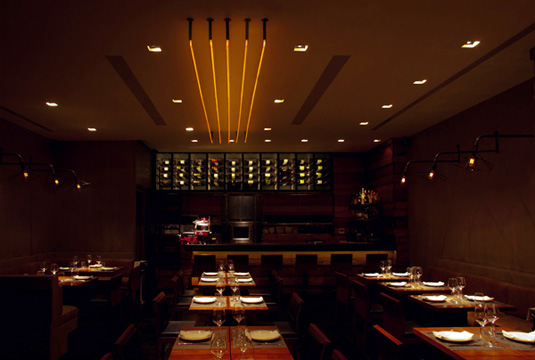
The central luminaire derives from the imaginary orange lines running parallel to the road that show up in photographs. Even though they are not visible to the eye when you walk down a street, these lines are traced by any light source at night, and they capture the intensity and the directions of the urban landscape.
Made of neon, it gives depth to the space and emphasises the main part of the venue, the kitchen. Starting from the kitchen, the lines end at the restaurant’s glazed façade, near the sign. The neon sign has the same light tone as the ceiling fixture and is painted black on the outside, and its presence is felt through its indirect, reflected light.
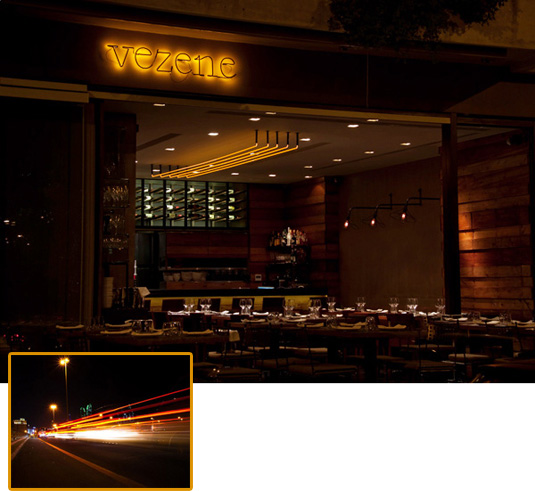
The restaurant’s urban mood is sketched out with light, creating a warm and welcoming atmosphere accompanied by distinctive music, and prompting visitors to seek out a new experience of both taste and sight.
Luminaire Design and Architectural Lighting Design: Marisa Galani, Rania Maha
Text: Marisa Galani, Rania Maha
Project: Vezene, 11 Vrasida Street, Hilton area, Athens
Date: 2011
Photographs: Rania Maha, Lefteris Pantavos
Source: www.design-district.gr