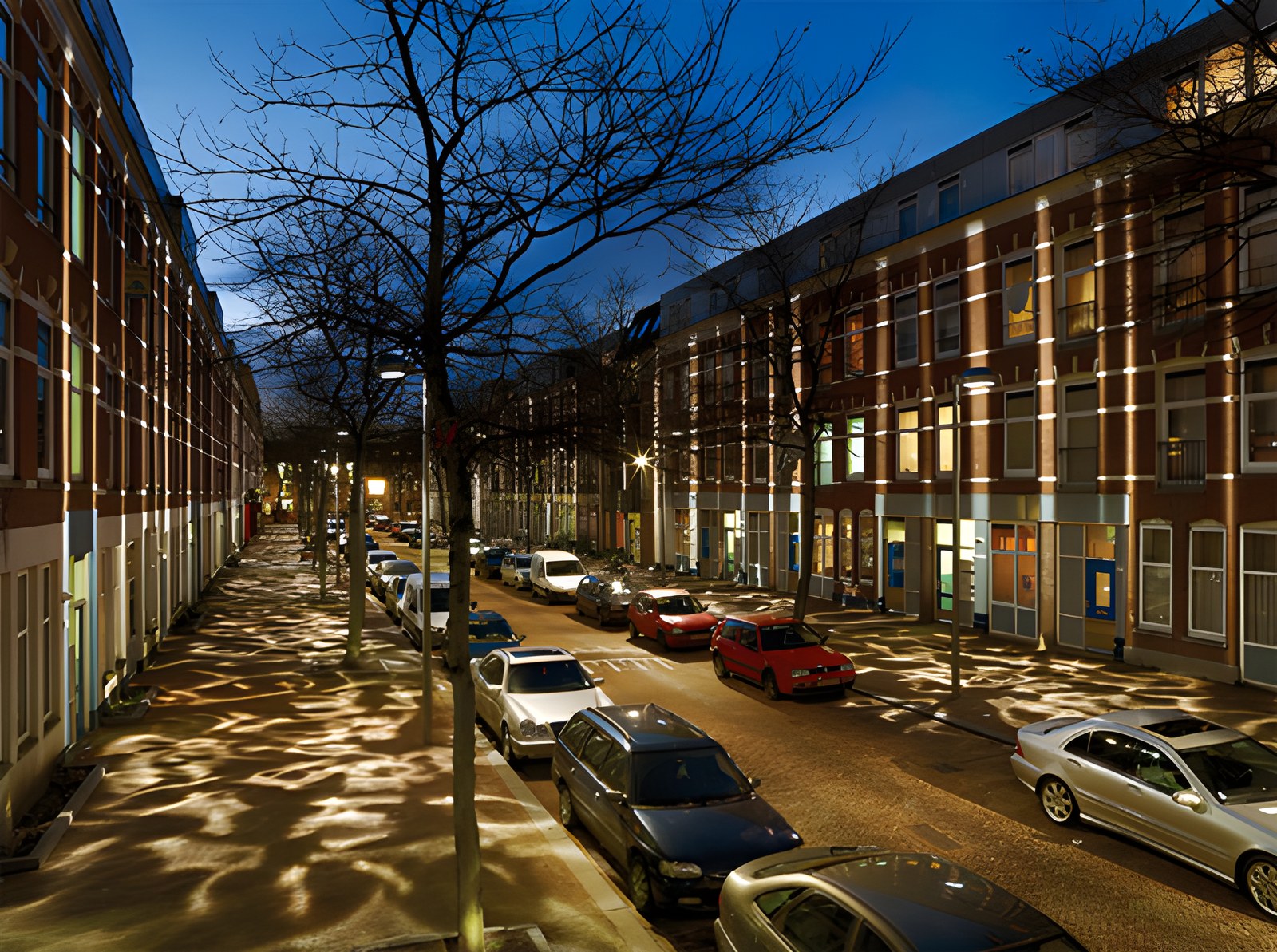
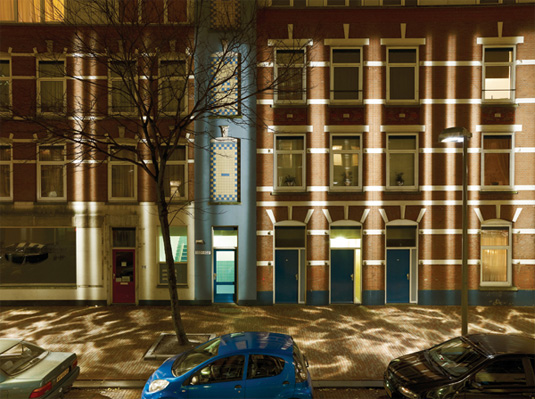
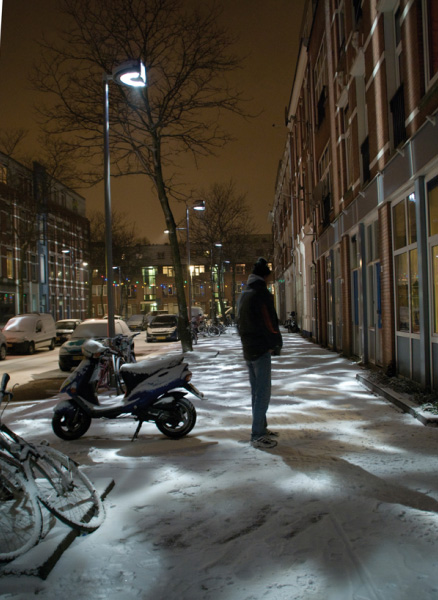
If you visit Atjehstraat in the Katendrecht district of Rotterdam, you will find yourself in a distinctive neighbourhood. Where you once would have found ordinary street lamps, you now encounter patterns of light, such as columns of light on the house façades and abstract shapes along the pavement. The idea, which grew out of a rethinking of the traditional streetscape and has had a significant impact on the street’s aesthetic renewal, was named Broken Light. Its implementation helped reduce the crime that had plagued the area, strengthening community ties. The new look of Atjehstraat is part of a broader effort to upgrade the district.
In 2007, the arts organisation Stiching DSPS issued a challenge: to create a plan that would revitalise the area and at the same time spark a debate about the lighting of public spaces. The challenge caught the interest of lighting designer and visual artist Rudolf Teunissen. Together with designer Philipp Stegmüller, he began researching the significance of light, with the aim of understanding exactly how people perceive and experience it in public spaces.
They found that the language of light permeates every dimension of culture. Art, in the form of photography, film, painting and so on, has built up a library, or database, of visual references that act as a filter on real life.
The two designers also found that the terminology used in lighting has made its way into everyday language. It is also used metaphorically to express various situations, for example “he was left in the dark” or “new information came to light”.
In short, light and darkness are concepts charged with meaning, a meaning that is constantly shaped by, and in turn shapes, the way we perceive the illuminated environment around us.
Teunissen’s next step was to create a design for Atjehstraat that would unite “real light” (what we see) with “translated light” (what we experience emotionally). Broken Light developed from this foundation.
The designers realised early on that what they were really looking for was a meaning of light that is also supported by experience. They wanted to show that a lighting concept is not only about how a space is perceived, but also about how it can support the space’s identity.
Rather than using light as a purely practical solution (the safety it provides against the dangers that lurk in the dark), Teunissen built it into the idea of identity. The practical side of the issue naturally had to be taken into account as well. There was a strong desire to avoid the negative qualities of street lighting, to prevent glare and to reduce light “pollution”. Beyond that, Teunissen wanted to create a “lichtraum”: a space made of light, giving the street a different character even during the day.
Making such significant changes, however, required the consent of the city authorities and, of course, the residents. Stiching DPS acted as intermediary throughout the project. In 2009 it staged a demonstration using a prototype luminaire, and in November 2010 it organised a small celebration for the official “flicking of the switch”.
Implementing the design meant removing the existing lighting poles and replacing them with 18 new units, 9 on each side of the street. Each new pole is 6 metres high, and its custom-made luminaire is aimed at the building façades. These luminaires also form the vertical designs and the patterns on the ground.
Each of the luminaires that create the effects had to be adjusted so that the beams of light focus precisely, avoiding the windows. In this way, anyone can enjoy the new scene, whether they are inside a building or out on the street.
The reflectors were built by Marinus van der Voorden following specialised calculations. The fittings were made by the industrial design firm Max Designers under the supervision of Thomas Linders.
Regulations required the street to be evenly lit, so fittings were installed on the kerbs next to every second lamp along the street. The fittings are mounted at a height of 5 metres on a small frame and tilted slightly, so that only one pole in each pair carries a luminaire. The roadway is thus lit precisely without affecting the rest of the scheme. From above, these unconventional shapes look like graffiti, as if someone had sprayed light onto the pavement. At street level, the designs look like abstract shapes of birds and flowers. Indeed, this play with different interpretations and depictions of light was deliberate from the start, and the residents’ reaction has been entirely positive.
Through this project, Teunissen has shown that imaginative solutions can be both practical and functional. In essence, an entire district can be lit by creating contrasts, without visual obstruction from unwanted reflections. Using Atjehstraat as a working model, he hopes to continue applying his technique, adapting Broken Light to new environments.