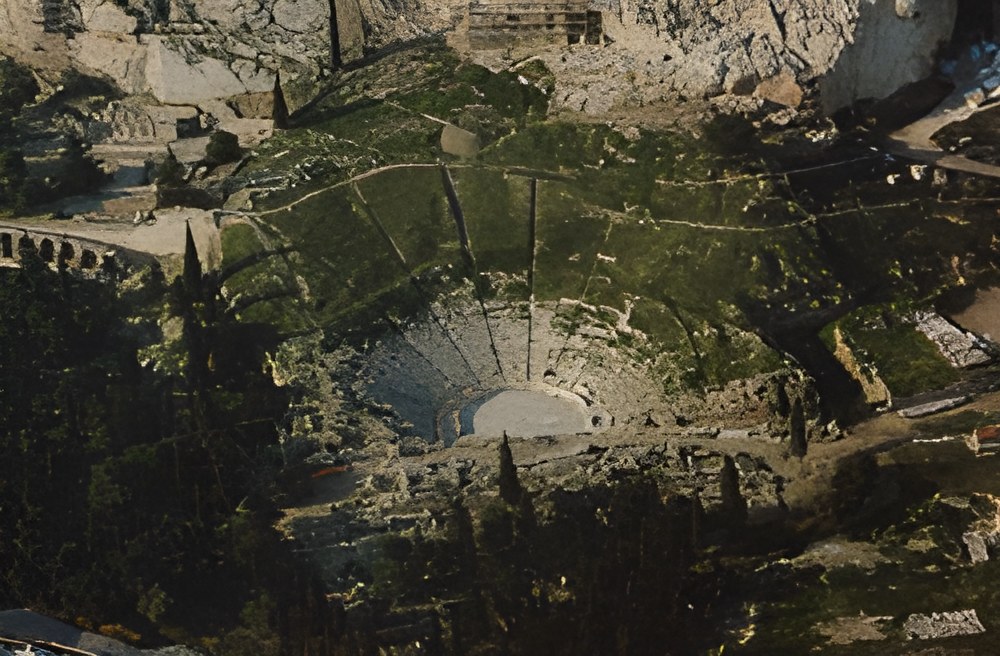
The ancient Theatre of Dionysus is the most important monument on the south slope of the Acropolis, since it was here, in the 5th century BC, that the greatest works of ancient drama were presented to the Athenian public. At that time the auditorium (koilon) was simpler and more limited in extent; it took its final form after the middle of the 4th century BC, when the orator Lycurgus managed Athens’ public finances.
The theatre was abandoned at the end of antiquity and was gradually buried under fill during the Middle Ages. It was rediscovered and excavated between 1862 and 1895. In 2003 a study was drawn up for the restoration of the auditorium, and a series of individual anastylosis interventions was defined for its gradual restoration.
The architecture of the monument is an exquisite example of the Classical period. The seats are made of finely carved limestone from the coast of Piraeus, while the front-row seats, the proedria, are admirable works of marble craftsmanship, with the titles of the priests and officials entitled to them carved on each throne.
The effort begun in 2003 by the director Michael Cacoyannis to light the monuments of the Acropolis at night, illuminating the monuments of the Sacred Rock on the basis of studies by Pierre Bideau and Kostas Kapos, was continued on the initiative of Philips Hellas, which sponsored the design and complete installation of the lighting scheme highlighting this important monument.
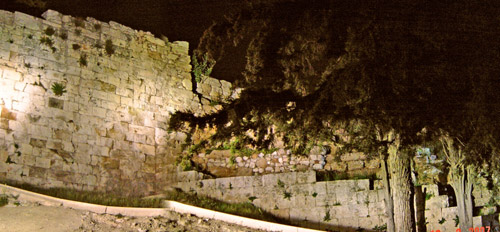
The design and the supervision of the works were entrusted to the lighting designer Kostas Kapos, so that the lighting and aesthetic result would be consistent with the lighting philosophy applied to all the monuments of the Acropolis, a scheme he had also designed on the basis of proposals by Pierre Bideau.
The site of the ancient theatre presents a number of lighting difficulties, similar to those encountered in the design and installation of the lighting at the archaeological site of Eleusis. Specifically, the area has no pronounced relief, contains no buildings or other architectural projections, and is hard to see from the perimeter of the archaeological site because a cluster of trees stands in the way. The lighting designer must therefore help the viewer to “read” the monument from a distance at which its individual architectural features blur together. All this determined from the outset that the final result could in no way be the same as that of the Parthenon, where it was possible to highlight each architectural member individually using suitable floodlights and polarising filters.


The site is lit by 52 Philips Decoflood MVF-606 floodlights with wide, medium or narrow beam reflectors, each fitted with a 150W CDM-T ceramic metal halide lamp, producing white light at 3000 and 4200°K. These floodlights were delivered from the factory painted in RAL 1016, to match the colour of the theatre’s marble members, and were installed with either an anti-glare louvre or a polarising filter that spreads the beam horizontally, depending on the needs of each location. In cooperation with the architects and archaeologists responsible for the site, 9 lighting positions were selected, where 7 Π-shaped frames and 2 poles were installed to carry the floodlights. The positions were chosen both for the desired lighting result and for the particular aesthetic requirements of the site, so that the floodlights are not especially visible in the morning hours and do not affect the image of the monument.
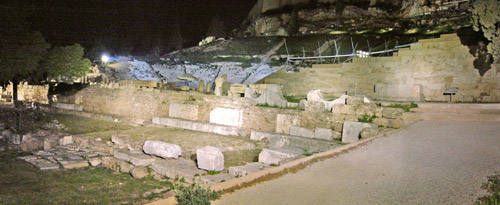
The cable routes were laid at a shallow depth so as not to damage ancient members still lying in the ground. Even so, particular care was taken to achieve an installation that is operationally safe and will not face problems in the future from mechanical stress, weathering or electrical faults. Besides, the designer’s previous experience in lighting highly significant archaeological sites was enough for the study to be approved by the Central Archaeological Council without any problems or comments.
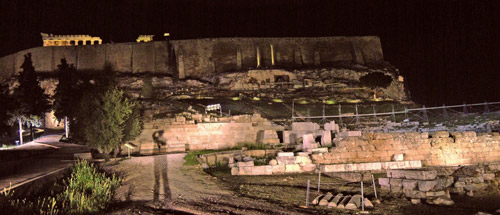
The final lighting result is an alternation of warmer white beams with cooler ones, creating a sense of the site’s relief from a distance. The surviving seats of the auditorium are lit with 4200°K white light, which brings out the natural colour of the marble and limestone, while the area of the epitheatron bordering the already lit perimeter of the Sacred Rock is lit with warmer white light at 3000°K.
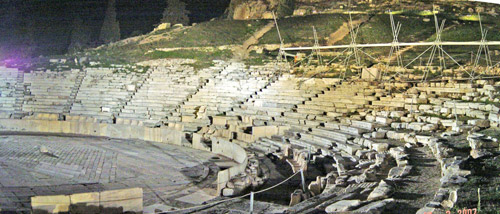
The retaining walls (analemmata) of the theatre’s parodoi, together with those on its east and west sides, were lit with both polarised and ordinary beams, alternating the shades of white light where necessary to bring out their relief. General highlighting lighting was also provided for the remains of the sanctuary of Dionysus, which stood on the south side of the theatre. Unfortunately, as mentioned above, because of the relatively slight relief of the area, the lighting result as a whole can be appreciated in its full extent only from an aerial photograph.

A project of this kind could not have been realised without the selfless cooperation of many people. The architect-engineer Mr Konstantinos Boletis of the Committee for the Restoration of the Theatre of Dionysus and the archaeologist Ms Sofia Moschonisioti of the 1st Ephorate of Prehistoric and Classical Antiquities (Α’ ΕΠΚΑ) were the key figures (among many other scientists) in the final shaping of the project on behalf of the Ministry of Culture. As in all previous projects, the contribution and help of the electrical engineer Mr Sp. Economopoulos of the YSMA (the Directorate for the Conservation of Ancient Monuments) were invaluable and decisive. Finally, the harmonious cooperation of Mr Kon. Pezoulas of Philips Hellas and Mr Sot. Vlachos and Mr I. Evangelou of Alexandros Technical SA contributed to the skilful, high-quality completion of the works.
Kostas M. Kapos
Mechanical Engineer, M.Sc.
Architectural Lighting Consultant
kapos@tee.gr