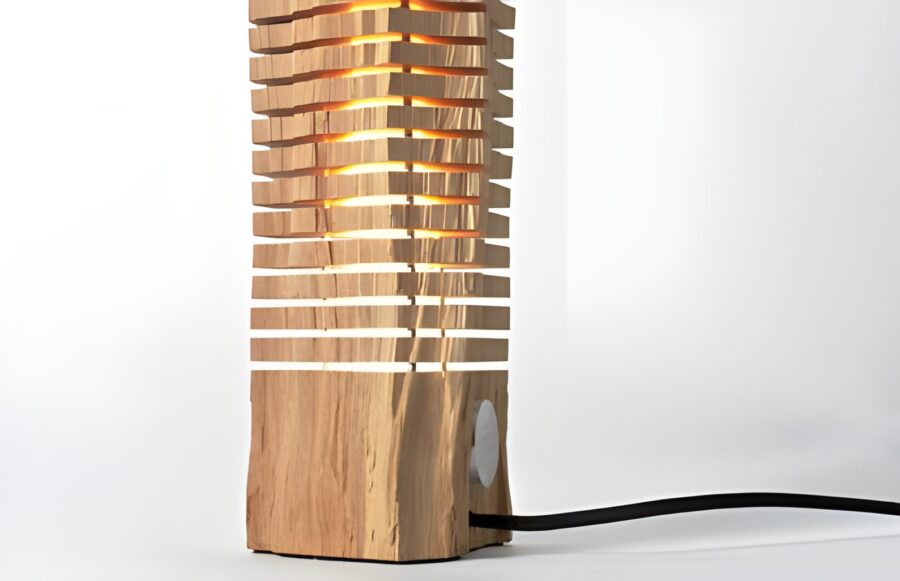
1. The self-illuminated space has been the global trend of the last decade. You have supported and followed it in your projects since 1996. How would you define it today, now that Greece is only beginning to get to know it?
In this trend, the luminaires remain hidden and the light seems to invite itself in. Whether cool or warm, it appears without revealing its source. The presence of the luminaire is necessary only as an object in its own right, with the same value a sculpture might have.
The “self-illuminated space” does not cancel out the presence of luminaires. On the contrary, it uses them, not to cover up an aesthetic awkwardness but to complete the final image of the project.
Historically, I would say the inspiration came from the theatre and later passed into architecture, both exterior and interior.
2. Why do you remain such a loyal supporter of this trend?
The type of lighting I have chosen to practise is the answer I gave myself when I asked what lighting is and what kind of lighting I like.
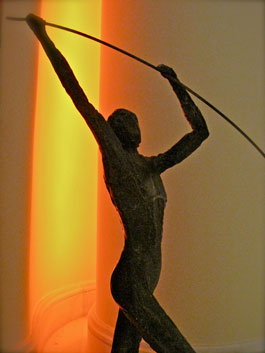
Many times, in spaces with intense glare, I would put my hand over my eyes to hide the luminaires and see only the result. The space then became a different space: friendlier, with depth and perspective, a space that suddenly revealed its features, its objects and, in the case of shops, the products it housed.
Usually, the only reason for the presence of luminaires was, and still is today, convenience for designers and manufacturers. It was a habit that became a fashion in the decade 1990-2000, and the result was that on seeing a space we would say, “Ooh, what lovely luminaires!” Most companies, of course, followed the trend, often making what was essentially the same fitting in nickel, chrome, white, black, round, square and so on. The products of good companies dealt with glare. All the other companies, exploiting people’s ignorance, considered it unnecessary and turned the rule into a fashion: “if you can’t light them, DAZZLE THEM”.
I like the fact that people feel more and more strongly the need to live, work and socialise in spaces that bring them closer to their emotional, creative selves. Spaces are becoming plainer, with nothing accidental and nothing superfluous. Little by little we are discovering that our need for balance and harmony also calls for the “right lighting”, both literally and figuratively.


3. In this trend, light sources are built into the space to create a sensual, theatrical effect. Doesn’t that require complete cooperation between the lighting designer and the architectural team, so that goals are set from the earliest stages of the project?
Exactly, especially when we are talking about a lighting “design” and not a “proposal”. The sooner the architect calls in the lighting designer, the better. As a rule, I would say, this process ideally begins at the concrete stage. That limits the chances of “quick” fixes and allows the necessary infrastructure to be put in place so that light and space become one, which is easier to achieve at the start of a project.
After all, it is now widely accepted that lighting has the power to “build up or break down” a space. In fact, lighting is itself a structural element, not of the construction, of course, but of the image of the construction. So it is good for a space to be created together with its light.


4. Given what has come out of our discussion, could a designer who applies the “self-illuminated space” approach be described as a theatrical lighting designer? If so, how would you distinguish them from an architectural lighting designer?
Of course not! The technical training, and the knowledge of lighting equipment and lighting materials more generally, that one professional is expected to have are completely different from the other’s, because the needs are completely different. In the theatre the stage is a kind of projection, set up in specific positions, and the spectator is likewise static, also in specific positions. In architectural lighting, although the lighting designer also creates lighting “scenes” in the space, the “spectators” move within the projection. They live, work and shop there. So here we are talking about an applied art in which the artistic approach is also seen through the prism of functionality.

5. In a recent article we published on flashlight.gr, Mr Eaglen described the work of architectural lighting designers as somewhat boring. Do you agree?
To begin with, every trend or approach to lighting is architectural lighting, since it lights spaces.
I believe Mr Eaglen was referring to “Architectural Lighting” as one specific way of lighting spaces. That kind is the lighting that some architects produced, or that company consultants were trained to produce. With the help of ever more advanced lighting design software, such results look increasingly polished and flawless, but without any interest, like a perfect dinner table with no flavour, or a beautiful person with no feelings. Boring indeed.
Mr Eaglen is obviously calling the rational understanding of lighting boring, whereas the self-illuminated space demands an emotional approach. Lighting is by definition an art of emotions. It is the accent, the punctuation.
That said, knowing that lighting is needed everywhere, in every space, since without it there is no space, I accept that many spaces, such as banks, supermarkets and department stores, where our actions are entirely specific, probably need nothing more than some knowledge of lighting equipment, a lighting program and someone to operate it. But in the exhibition space of a museum, in a gallery, a restaurant, a café, a home, and often in a shop too, it is important to highlight and support the aesthetic, poetic side of the space. In painting, it is not technology that determines the quality of the art or of the artist, but the content and the way the lighting designer translates the creator’s ideas.

6. In your opinion, what makes the outcome of a design successful? Do you think there are objective and subjective criteria for evaluating a project?
The measurable quantities of architectural lighting consist of phenomena that are easy to subject to technical testing, such as glare, radiation, unwanted reflections, light pollution of the environment, EU regulations, energy saving and CO2, safety, desired lighting levels and so on. Nevertheless, precisely because it is “architectural design”, it suffers from the peculiarities, and enjoys the advantages, that architectural freedom and personal viewpoint bring. Paving the floors of a house with marble has no measurable effect on the architectural (as opposed to the engineering) project, yet for the people living in the house that choice plays a significant role every day. In the same way, the most important results and characteristics of lighting cannot be recorded in measurable quantities.
The only measurable indicator of success I would add to the above for a lighting design is correctly placed variations in brightness and properly designed shadows.
Beyond that, the result of a lighting scheme can be judged successful when we feel good in the space from the start but cannot, at least immediately, say why. We simply feel good and like being there. We can function, exist, and do tirelessly whatever the space invites us to do. We feel welcome, and during our stay we encounter pleasant surprises, surprises that, although they exist in their own space, also coexist with all the other spaces, creating lighting associations.

7. Can this trend be applied to a complete space, which presumably you are called on to deal with very often? For example, the home or office I have just moved into?
There are now a great many applications that could be used, and many luminaires that could be placed in a space and contribute to such a final lighting result. Even so, it is usually a good idea for the space to be able to take a coat of paint, a refresh, once the installation work is finished.