PAGE 1: Introduction, Infrastructure PAGE 2: Education, Research, Services PAGE 3: Research and development programmes, Publications
1. INTRODUCTION
The Lighting Laboratory of the National Technical University of Athens began operating around 1955 as part of the activities of the High Voltage and Electrical Measurements Laboratory. It later evolved into an independent laboratory unit with distinct activities in the fields of lighting and photometry. To this day it remains the only university laboratory in Greece dedicated to lighting technology. It belongs to the School of Electrical and Computer Engineering.
2. INFRASTRUCTURE
The laboratory’s equipment serves its three main activities: laboratory training for students, scientific research, and photometric measurements of lighting equipment produced by Greek manufacturing companies.
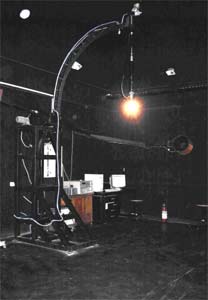
Among the Laboratory’s most important instruments are three goniophotometers for measuring the luminous intensity distribution of luminaires. The first rotates the luminaire (CIE type 3). The source rotates about a vertical and/or horizontal axis (Figure 1), while the photometer head stays fixed. The distance between the luminaire and the photosensor can be varied so that luminaires of any size can be measured. This setup is used for photometric testing of various types of indoor and outdoor luminaires. An auxiliary sensor makes it possible to measure luminaires regardless of the burning position of their lamps.
Figure 1 Goniophotometer with rotating luminaire (CIE type 3).
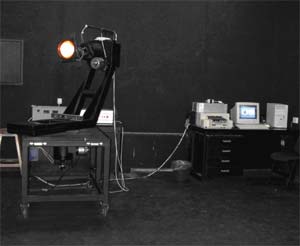
Measurements are taken in the standard C-planes or on conical surfaces. The setup has undergone some mechanical modifications that made measurements in the A and B planes possible. The system is fully automated and computer-controlled.
The second instrument is an old spiral goniophotometer that was recently converted into a goniophotometer with a moving photometer head (CIE type 1). The luminaire rotates about a vertical axis while remaining in the same position (Figure 2). The photometer head moves in a vertical plane, along a circle centred on the luminaire. Measurements are taken in the A, B or C planes. This goniophotometer is also used to measure the luminous flux of light sources by integrating the intensity distribution over a spherical surface.
Figure 2 Goniophotometer with moving photosensor (CIE type 1).
The third goniophotometer was developed in the Laboratory by postgraduate students for measuring small light sources and signal lights (marine, aviation and so on). It resembles the first, but is distinguished by its small size and by how easily it can be moved to another measurement site. All of the above goniophotometers are fully automated and controlled by a personal computer.
In addition, there is an entirely manual system used only for students’ laboratory training. The Laboratory’s equipment also includes research photometers with heads for measuring illuminance, luminance and radiant intensity.
Illuminance instruments are calibrated using standard light sources calibrated in units of luminous intensity by accredited laboratories. The Laboratory also has portable instruments for measuring illuminance, the luminance of computer screens and the luminance of road surfaces.
Three integrating spheres (Ulbricht) are used for measuring the luminous flux and efficiency of luminaires, and for measuring the colour and reflectance of materials.
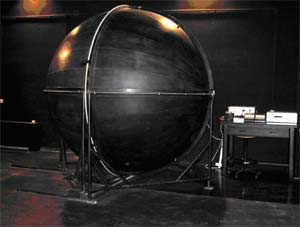
The first, 2.5 m in diameter (Figure 3), is used mainly for measuring the luminous flux of lamps and the light output ratio (LOR) of luminaires of all types (indoor and outdoor). It is also used to measure the light output of emergency luminaires over the period of their discharge.
The second sphere, 1 m in diameter, is used mainly for measuring the luminous flux of lamps, using the Laboratory’s standard light sources (calibrated in units of luminous flux) and standard ballasts.
Figure 3 Integrating sphere, 2.5 m in diameter.
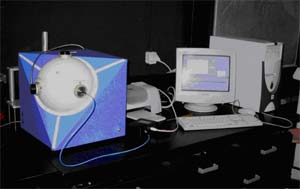
The third integrating sphere (Figure 4), the smallest at 0.25 m in diameter, is used exclusively for measuring the colour and the reflectance or transmittance of optical materials (coloured lenses, diffusers, luminaire reflectors and so on).
Figure 4 Integrating sphere for measuring colour, reflectance and transmittance.
Colour measurements are carried out with several spectrophotometers. These include an old high-precision system with a monochromator and interchangeable sensors for ultraviolet radiation (UV-A, B, C), visible light and infrared (IR-A, B). Most measurements, however, are made with two modern spectrophotometric setups with diffraction gratings (Figure 5).
Their operation is computer-controlled and the measurements are analysed with the relevant software. The first setup is used for colour measurements, while the other is used for measurements in the visible and ultraviolet ranges, since it is equipped with two diffraction gratings, one for the visible range and one for the ultraviolet. These instruments are calibrated with standard light sources supplied by the instruments’ own manufacturer. Other sources, calibrated in units of blackbody colour temperature, are also available, mainly for research purposes.
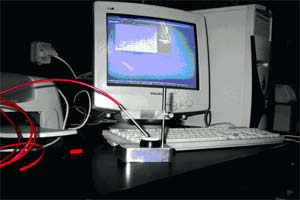
Figure 5 Reflectance measurement setup.
Beyond the above, the Laboratory’s equipment includes various instruments for electrical safety testing of lighting installation equipment. Examples include an artificial rain apparatus, temperature- and humidity-controlled chambers, power analysers, oscilloscopes, voltmeters, ammeters, frequency counters, thermocouples, data loggers, amplifiers, frequency generators, transformers, current and voltage sources, sampling systems and a fully equipped machine shop.
PAGE 1: Introduction, Infrastructure PAGE 2: Education, Research, Services PAGE 3: Research and development programmes, Publications
3. EDUCATION
The Laboratory’s primary activity is teaching lighting to students of the National Technical University of Athens. To this end, the course “Lighting Technology” is taught to 6th-semester students (3rd year of study), and includes 2 hours a week of lectures on lighting theory and photometry and 2 hours a week of laboratory practice and lighting design studies. Elements of lighting theory, with an emphasis on energy management, are taught in 2 courses of the Inter-departmental Postgraduate Programme “Energy Production and Management”.
Students’ laboratory training begins with measuring the light distribution of various types of luminaires and drawing their polar distribution diagrams. Next, the luminance distribution is calculated, glare diagrams are drawn and the glare class is determined according to current international specifications. Students also calculate the zonal distribution of luminous flux and the efficiency factors, and classify the luminaires according to the most widely used methods internationally. The measurements are taken with the available goniophotometers, either the automated ones or the manual one designed specifically for teaching purposes.
The exercises also include measuring the luminous flux of lamps and luminaires with the Laboratory’s integrating spheres, or by goniophotometry and integration of the luminous intensity distribution.
The basic principles of colorimetry are also taught as part of the course, accompanied by measurements with spectrophotometers using monochromators or diffraction gratings. Students measure the spectrum of light sources and the colour (colour coordinates) of coloured materials, both transparent and opaque.
Elements of electromagnetic compatibility testing of luminaires (insertion loss) were recently added to the teaching programme.
Beyond the above, students carry out independent projects such as special lighting studies (of building façades, churches, stadiums and so on) and photometric measurements (of road surface luminance and so on), and sometimes build small circuits (lasers, light sensors, angle meters and so on). The final grade is the sum of the marks obtained in the written exam, the laboratory practice and the independent project.
The last semester of the curriculum is devoted exclusively to the diploma thesis. Some students choose lighting and photometry for their thesis. Topics range from lighting studies and the rational use of energy in lighting installations to experimental research and software development. Some of these theses form part of the Laboratory’s broader research programmes, and some students receive funding for their participation.
4. RESEARCH
Scientific research is carried out by the Laboratory’s permanent staff, but mainly by PhD candidates and other postgraduate students. One of the major research subjects is mesopic vision. Two PhD candidates are working with a significant number of human subjects of various ages to determine experimentally the sensitivity of the human eye in the mesopic range. A further PhD candidate is writing his dissertation on road safety under mesopic vision conditions. Research on these subjects also includes measuring the mesopic characteristics of light sources and their actual luminous efficacy at mesopic levels. The photometric parameters of commercially available lamps are being examined under various visual conditions. At the same time, a series of laboratory tests is under way throughout the lamps’ life, using conventional and electronic control gear, and even at specific dimming levels. The tests include measuring all photometric and electrical characteristics, and extend to the spectral distribution of the light produced, the variation in luminous flux and harmonic distortion.
Some undergraduate and postgraduate students, but mainly one PhD candidate, are working on the rational use of energy in lighting systems and the exploitation of daylight. The research includes intelligent systems that regulate artificial lighting according to the existing daylight, and exploitation of the optical properties of shading materials to make optimal use of daylight, among other things.
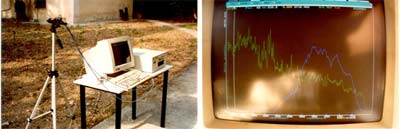
A PhD candidate contributed to the construction of a passive pyrheliometric scanner for the qualitative and quantitative determination of atmospheric constituents and aerosols (Figure 6). The system automatically tracks the path of the sun and records its spectrum in the ultraviolet, visible and near-infrared ranges (180-1000 nm with a resolution of 0.5 nm). Software developed by one of the project’s partners calculates the atmospheric constituents and pollutants.
Figure 6 Passive solar radiation scanner for measuring atmospheric pollutants.
Another PhD candidate is researching the simulation of fluorescent lamps with electronic control gear, in particular the “light flicker” phenomenon, which occurs when the lamp is supplied with a sinusoidal voltage amplitude-modulated by a lower-frequency sinusoidal signal or distorted by inter-harmonics. In the same area, another candidate is modelling the ageing of the fluorescent lamp’s electrodes and predicting the lamp’s life through measurements.
Another research subject is the experimental investigation of the photometric and electrical characteristics of compact fluorescent lamps with electronic control gear, and the determination of the consequences for energy consumption and power quality if they are used on a large scale to replace incandescent lamps. One PhD candidate is working on this subject experimentally and a second theoretically. As part of the research, a measurement setup was developed in the LabView environment, with real and virtual instruments, for power measurement and harmonic analysis of discharge lamps. The system includes a spectrum and power analyser and a waveform generator for supplying the lamps with distorted voltages. The second PhD candidate has simulated various real electrical grids to analyse and calculate harmonic distortion under different scenarios of compact fluorescent lamp penetration. Some of the simulations concern the weak electrical grids of isolated Greek islands supplied by renewable energy sources, where the distortion may exceed internationally permitted limits.
The Laboratory has recently become involved in renewable energy application projects. As part of this research, a stand-alone and a semi-autonomous street lighting system with a photovoltaic cell have been studied. Funding is currently being sought to build the prototype, with the first aim of lighting the outdoor areas of the Polytechnic campus so that its efficiency and behaviour can be tested under real operating conditions.
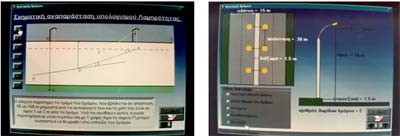
Another group of students developed a software package for road lighting studies (Figure 7), open to any luminaire manufacturer who wishes to enter the data for their own luminaires.
Figure 7 “Roadlux”: software for road lighting studies.
5. SERVICES
One of the Laboratory’s most important activities is carrying out photometric measurements and quality control tests on lighting installation equipment. The tests are conducted in accordance with the applicable international, European and national standards. The photometric test reports issued are in two languages (Greek and English) for use outside the country’s borders. In practice, all types of luminaires and light sources are measured: indoor and outdoor luminaires, emergency luminaires, signal lights (road traffic, marine, aviation and others), reflective signs, luminaire diffusers and reflectors, and so on.
The most common measurements are the following:
1) Luminous intensity distribution of luminaires of all types,
2) Luminous flux of luminaires and lamps of all types,
3) Luminance and glare class of light sources,
4) Luminance of surfaces (screens, roads and so on),
5) Colour of transparent and opaque materials,
6) Colour and spectrum of light sources,
7) Reflectance, transmittance and absorptance of various materials,
8) Lamp life.
Electrical measurements and safety tests on luminaires (under artificial rain, humidity, temperature and so on) were carried out in the past, and the capability still exists, but the activity was discontinued because of the workload in the field of photometric measurements.
The Laboratory’s services are used by a number of manufacturers of luminaires and other lighting products, who use the photometric results to promote their sales or exports and to bid for private- or public-sector projects. Sometimes the photometric measurements are used to develop or improve new products, in which case the Laboratory’s role is advisory. Projects of this kind have been funded by national or EU programmes for industrial research, certification, export promotion and so on.
PAGE 1: Introduction, Infrastructure PAGE 2: Education, Research, Services PAGE 3: Research and development programmes, Publications
6. RESEARCH & DEVELOPMENT PROGRAMMES
The Laboratory carries out (or has already carried out) research and development programmes, as well as service projects, funded mainly by private companies but also by the wider public sector and the European Union. The projects of recent years are as follows:
1. “Development of a system for automatic adjustment of artificial lighting aimed at optimal use of daylight” (2005-2007), funded by the “Pythagoras” Programme, Operational Programme for Education and Initial Vocational Training (EPEAEK), Action Category 2.2.3.st, Measure 2.2, Action 2.2.3.
2. “Development of a model for determining photometric quantities in the mesopic vision range” (2004-2006), “Protagoras” basic research support programme, funded by the Senate Committee for Basic Research of the National Technical University of Athens.
3. “Energy audits of wind farms, small hydroelectric projects, photovoltaic systems, passive solar systems, cogeneration plants, biomass plants and energy-saving installations” (2002-08), Operational Programme “Competitiveness” – Measure 2.1.3, funded by ELANET.
4. “Quality assurance in the luminaire manufacturing sector” (2002-07), funded by Greek manufacturers of lighting installation equipment.
5. “Experimental evaluation of the electrical and photometric characteristics of electronic fluorescent lamps and estimate of the energy savings and of the disturbances that their extensive use will cause in the electrical grids of Greece and Yugoslavia” (2002-04), Greece-Yugoslavia bilateral scientific co-operation programme, funded by the General Secretariat for Research & Technology.
6. “Energy savings in lighting installations with electronic fluorescent lamps and techno-economic assessment of their extensive use in the national electrical grids of Greece and Yugoslavia” (2000-2001), Co-operation programme with Balkan and Black Sea countries, funded by the National Technical University of Athens.
7. “Energy savings in lighting installations using compact fluorescent lamps with electronic gear” (2000-01), Co-operation between Balkan Countries, financed by the Research Committee of National Technical University of Athens.
8. “Reseau de formation continue energie – environnement – EPURE” (1998-2002), TEMPUS PHARE, Joint European Project Grant, Contract No. AC_JEP-13076/98.
9. “Efficiency of compact fluorescent lamps and harmonic distortion in distribution networks” (1998-1999), Balkan countries co-operation programme, funded by the National Technical University of Athens.
10. “Feasibility study for the establishment of a luminaire safety laboratory” (1997), funded by the Hellenic Organization for Standardization (ELOT).
11. “Development of light transfer model and design of modern laboratory techniques for the measurement of light parameters” (1997-1998), Balkan countries co-operation programme, funded by the National Technical University of Athens.
12. “Quality assessment procedures and development plan for continuing education at the English Language Department of Engineering at the Technical University of Sofia”, TEMPUS-Phare, Complementary Measures Grant 1995-96, Contract No. CME-01033-95.
13. “Technological support for companies manufacturing medium- and low-voltage electrical equipment” (1996-2000), funded by Greek manufacturers of lighting and electrical equipment.
14. ERASMUS, Contract STV-95-G-1073/P (1995-1996).
15. “Improvement of laboratory equipment and promotion of the research work of the Lighting Laboratory” (1995-2001), funded by Greek manufacturers of lighting installation equipment.
16. “Design, optimisation and quality control of lighting equipment” (1995-1999), funded by Greek manufacturers of lighting installation equipment.
17. “Feasibility study for the establishment of the Lavrio Technology Park” (1994), funded by the General Secretariat for Research & Technology.
18. ERASMUS, Programme ICP-93-D-3066/06 (1993), financed by the European Union.
19. “Feasibility study for the establishment of the Volos Technology Park” (1993), funded by the Prefecture of Magnesia.
20. “Design and construction of a passive pyrheliometric scanner for the qualitative and quantitative recording of the constituents and aerosols of the atmosphere” (1994-1995), EPET I, Measure 1.5/New Projects, funded by the European Union.
7. PUBLICATIONS
1. N.V. Bisketzis, G.I. Polymeropoulos, F.V. Topalis: “Advantages of the mesopic approach for road lighting vs. the traditional photopic considerations”, Lighting in the XXI Century: Midterm Meeting of the Commission Internationale de l’Eclairage (CIE) and International Lighting Congress, Leon, Spain, 18-21 May 2005.
2. I. Kateri, C. Orfanos, F.V. Topalis: “Experimental investigation of the luminous flux variation of fluorescent lamps caused by interharmonics and flicker of supply voltage”, Lighting in the XXI Century: Midterm Meeting of the Commission Internationale de l’Eclairage (CIE) and International Lighting Congress, Leon, Spain, 18-21 May 2005.
3. Z. Radakovic, F.V. Topalis, M.B. Kostic: “The voltage distortion in low voltage networks caused by compact fluorescent lamps with electronic gear”, Electric Power System Research, Vol. 73, Issue 2, pp. 129-136, February 2005.
4. S.A. Suflis, I.E. Chatzakis, F.V. Topalis: “Influence of energy saving lamps on the power quality of low voltage networks in commercial and residential areas”, Proceedings of the 4th Mediterranean Conference on Power Generation, Transmission and Distribution, Med Power 2004, Lemesos, Cyprus, 14-17 November 2004.
5. C. Orfanos, F.V. Topalis “A virtual energy analyser for harmonic measurements on discharge lamps”, Proceedings of 13th International Symposium on Measurements for Research and Industry Applications of the International Measurement Confederation (IMEKO), Athens, Greece, 29th September-1st October 2004.
6. E. Gluskin, F.V. Topalis, N. Bisketzis, A. Peled: “Fluorescent lighting and human vision: A system point of view”, Proceedings of 4th International Conference on Photo-Excited Processes and Applications, Lecce, Italy, 5-9 September 2004.
7. F. Korovesis, G.A. Vokas, I.F. Gonos, F.V. Topalis: “Influence of large scale installation of energy saving lamps on the line voltage distortion of a weak network supplied by photovoltaic station”. IEEE Transactions on Power Delivery, Vol. 19, No. 4, October 2004.
8. I. Kateri, N. Chondrakis, F. V. Topalis: “A pilot study for the determination of the energy saving potential in a typical school building by utilization of daylighting”, Word Scientific and Engineering Society Transactions on Circuits and Systems, Issue 5, Volume 3, pp. 1323-1328, July 2004.
9. S. Ioan, S. Hurdubetiu, F. V. Topalis: “Experimental value of network harmonic impedance”, Word Scientific and Engineering Society Transactions on Circuits and Systems, Issue 5, Volume 3, pp. 1362-1367, July 2004.
10. N. Bisketzis, G. Polymeropoulos, F. V. Topalis: “A mesopic vision approach for a better design of road lighting”, Word Scientific and Engineering Society Transactions on Circuits and Systems, Issue 5, Volume 3, pp. 1380-1385, July 2004.
11. S.A. Suflis, I.E. Chatzakis, F. V. Topalis, M.B. Kostic: “Scenarios for a large scale installation of compact fluorescent lamps: Influence on the power quality”, Word Scientific and Engineering Society Transactions on Circuits and Systems, Issue 5, Volume 3, pp. 1386-1391, July 2004.
12. C. Bouroussis, F. V. Topalis: “Optimization of potential and autonomy of a photovoltaic system for street lighting”, Word Scientific and Engineering Society Transactions on Circuits and Systems, Issue 5, Volume 3, pp. 1392-1397, July 2004.
13. F. V. Topalis: “Lighting education and research at the National Technical University of Athens”, Ingeneria Iluminatului, Vol. 5, No. 12, pp. 19-25, 2003
14. N. Bisketzis, G. Polymeropoulos, F.V. Topalis: “Some remarks on the mesopic vision in comparison with the photopic and scotopic vision”, Proceedings of Iluminat 2003, Cluj-Napoca, Romania, 8-9 May 2003.
15. C. Bourousis, M. Athanasopoulou, F.V. Topalis: “Semi-autonomous photovoltaic system for street lighting”, Proceedings of Iluminat 2003, Cluj-Napoca, Romania, 8-9 May 2003.
16. I. Kateri, N. Chondrakis, G.A. Vokas, F.V. Topalis: “Energy saving by utilization of daylight in school buildings”, Proceedings of Iluminat 2003, Cluj-Napoca, Romania, 8-9 May 2003.
17. F.V. Topalis, I.F. Gonos: “Incandescent or electronic lamps?”, monthly technical magazine “Ilektrologos”, Issue 137, pp. 52-56, Athens, April 2003.
18. F.V. Topalis, M.B. Kostic, Z.R. Radakovic: “Advantages and disadvantages of the use of compact fluorescent lamps with electronic control gear”, International Journal of Lighting Research and Technology, The Chartered Institution of Building Services Engineers, London, UK, CIBSE Series B, Vol. 34, No. 4, pp. 279-288, 2002.
19. C. Orfanos, I.F. Gonos, F.V. Topalis: “Harmonic power measurements on discharge lamps”, Proceedings of the 3rd Mediterranean Conference on Power Generation, Transmission and Distribution, Med Power 2002, Athens, Greece, 4-6 November 2002.
20. F. Korovesis, G.A. Vokas, I.F. Gonos, F.V. Topalis: “Power supply harmonic distortion in weak low-voltage networks due to large scale installation of energy saving lamps”, Proceedings of the 3rd Mediterranean Conference on Power Generation, Transmission and Distribution, Med Power 2002, Athens, Greece, 4-6 November 2002.
21. N. Bisketzis, G. Polymeropoulos, M.B. Kostic, F.V. Topalis: “Efficiency of road lighting installations from the point of view of mesopic vision”, Proceedings of the 3rd Mediterranean Conference on Power Generation, Transmission and Distribution, Med Power 2002, Athens, Greece, 4-6 November 2002.
22. C. Orfanos, F.V. Topalis: “A virtual instrumentation system for harmonic power measurements on discharge lamps”, Proceedings of the International Power Quality Conference 2002, Singapore, 21-25 October 2002.
23. F. V. Topalis, I.F. Gonos, G.A. Vokas: “Arbitrary waveform generator for harmonic distortion tests on compact fluorescent lamps”, Measurement, Journal of the International Measurement Confederation, London U.K.,Vol 30(4), pp 257-267, December 2001.
24. G.A. Vokas, I. F. Gonos, F. Korovesis, F.V. Topalis: “Influence of compact fluorescent lamps on the power quality of weak low voltage networks supplied by autonomous photovoltaic stations”, PowerTech’2001, Vol. 1, Porto, Portugal, 10-13 September, 2001.
25. A.D. Adamopoulos, H.D. Kambezidis, D. Zevgolis, F.V. Topalis: “Estimation of total ozone column over Athens using ground based beam solar irradiance measurements”, Fresenius Environmental Bulletin, CTA Publication, Munich, Germany, Vol. 9, No. 3/4, pp. 201-208, 2000.
26. E.K. Triantafilopoulou, I.F. Gonos, F.V. Topalis: “Development of a low-cost, fully automated goniophotometer”, Proceedings of the 10th Scientific Symposium on Metrology and Metrology Assurance, Sozopol, pp. 821-86, September 14-17, 2000.
27. A.D. Adamopoulos, H.D. Kambezidis, D. Zevgolis, F.V. Topalis: “Spectral analysis of solar radiation for the investigation of the atmosphere optical thickness”. Technologies for the renewable energy sources and the environment, Athens, December 2000, pp. 301-309.
28. F. V. Topalis, I. F. Gonos, M.B. Kostic: “Effects of changing line voltage on the harmonic current of compact fluorescent lamps”, Proceedings of the International Conference on Power and Energy Systems, Las Vegas, USA, November 8-10, 1999.
29. F.V. Topalis, A.A. Kanellias, E.K. Triantafilopoulou, V.D. Petrova, H.D. Kambezidis: “Spectral analysis of solar radiation for the determination of the air constituents and pollutants”, Proceedings of Balkan Light ’99, Varna, October 1999.
30. I.F. Gonos, M.B. Kostic, F.V. Topalis: “Harmonic distortion in electric power systems introduced by compact fluorescent lamps”, Proceedings of IEEE Budapest Power Tech, Paper BPT99-222-41, Budapest, Aug. 29-Sept. 2, 1999.
31. A.D. Adamopoulos, H.D. Kambezidis, D. Zevgolis, F.V. Topalis, V. Djepa: “Aerosol optical thickness through modified Langley-plots in the atmosphere of Athens”, Proceedings of 2nd ISES-Europe Solar Congress, Vol. 1, pp. I.1.1-1-7, Portoroz, Slovenia, September 14-17, 1998.
32. A.D. Adamopoulos, H.D. Kambezidis, D. Zevgolis, F.V. Topalis, V. Djepa: “Variability of total optical thickness in the atmosphere of Athens”, Proceedings of 2nd ISES-Europe Solar Congress, Vol. 1, pp. I.1.2-1-7, Portoroz, Slovenia, September 14-17, 1998.
33. H.D. Kambezidis, A.D. Adamopoulos, N.K. Sakellariou, F.V. Topalis, A.A. Kanellias, V.D. Petrova, D. Zevgolis: “Atmospheric chemistry and climate changes monitoring by a simple passive system”, Fresenius Environmental Bulletin, CTA Publication, Munich, Germany, Vol. 7, No. 1a/2a, pp. 20-26, 1998.
34. M.B. Kostic, F.V. Topalis: “Survey of the theoretical methods for the interior lighting calculations”, International Journal of Lighting Research and Technology, The Chartered Institution of Building Services Engineers, London, UK, CIBSE Series B, Vol. 30, No. 4, pp.151-157, 1998.
35. A.D. Adamopoulos, H.D. Kambezidis, D. Zevgolis, F.V. Topalis, V.D. Petrova: “Atmospheric optical spectral properties during summer days in Athens”, Fresenius Environmental Bulletin, CTA Publication, Munich, Germany, Vol. 7, No. 11/12, pp. 717-725, 1998.
36. E. Fokitis, G. Garipov, B. Khrenov, S. Maltezos, A.G. Kalydas, V. Kytopoulos, K. Manolatou, D. Papadimitriou, E. Papantonopoulos, P. Sommers, F. Topalis, A. Travlos, R. Vlastou, G. Kiriakidis, E. Chatzitheodoridis, K. Moschovis: “Status of optical filter development for AUGER fluorescence detector”, Workshop of Pierre Auger Collaborate Meeting, Itacarusa, Brazil, May 17-28, 1998.
37. E. Fokitis, A. Kanellias, B. Khrenov, V. Kytopoulos, S. Maltezos, K. Manolatou, R. Vlastou A.G. Kalydas, F. Topalis, A. Travlos, D Andrakakis: “Optical filter design R&D for AUGER fluorescence detector”, Workshop of Pierre Auger Collaborate Meeting, Utah, USA, June 6, 1997.
38. E. Zeinakis, K. Dimakis, F.V. Topalis: “ROADLUX: A program for exterior lighting studies in a Windows environment”, Bulletin of the Panhellenic Association of Graduate Mechanical and Electrical Engineers, Issue 296/97, pp. 58-62, Athens, May 1997.
39. H.D. Kambezidis, N.K. Sakellariou, F.V. Topalis, A.A. Kanellias, V.D. Petrova: “Air pollution monitoring with a passive pyrheliometric scanner”, Fresenius Environmental Bulletin, CTA Publication, Munich, Germany, Vol. 5, No. 11/12, pp. 631-636, November/December 1996.
40. H.D. Kampezidis, N.K. Sakellariou, F.V. Topalis, A.A. Kanellias, V.D. Petrova: “Passive pyrheliometric scanner space applications”, Earth Observation and Monitoring Systems, Proceedings of the 1st Workshop with the support of European Commission, DG XII, Hellenic Committee for Space Research and Technology, Athens, January 1995.
41. F.V. Topalis: “Energy saving in building lighting installations”, Bulletin of the Panhellenic Association of Graduate Mechanical and Electrical Engineers, Issue 267-94, pp. 45-54, Athens, October 1994.
42. F.V. Topalis: “Efficiency of energy saving lamps and harmonic distortion in distribution systems”, IEEE Transactions on Power Delivery, Vol. 8, No. 4, pp. 2038-2042, October 1993.