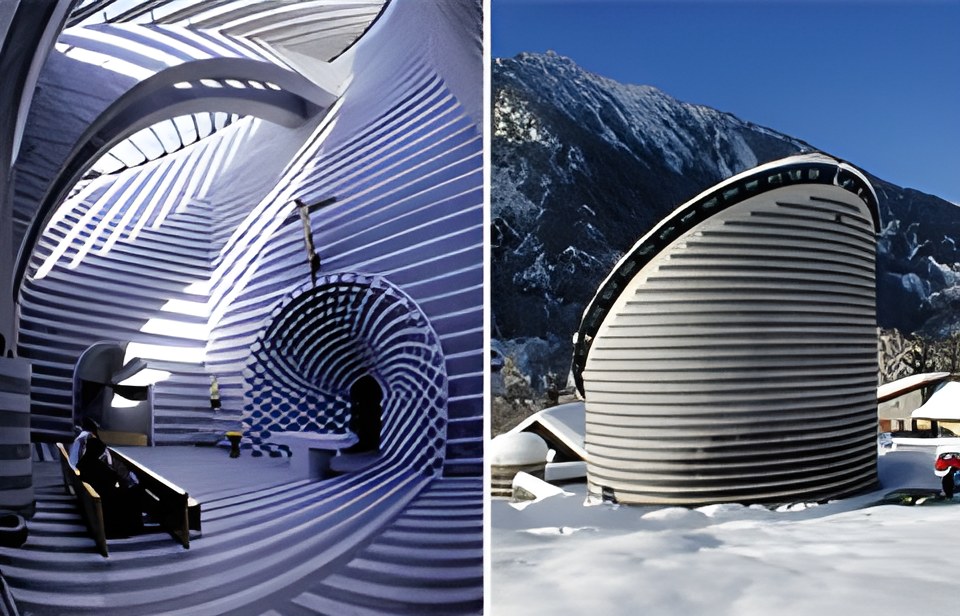
One example of architecture based purely on natural lighting is the Church of St John the Baptist, in the Alpine village of Mogno, in the Swiss canton of Ticino, at an altitude of 1,180 m. It was built between 1994 and 1996 on the site of an older church (1626), which had been destroyed by an avalanche in 1986.
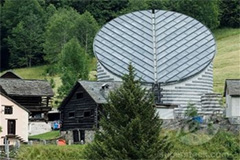
The new church was designed by the architect Mario Botta. It has a distinctive elliptical shape, and the building’s glass roof is sloped. The church is clad inside and out in grey Riveo granite and white Peccia marble, laid in alternating bands. The modern materials used in the building were designed by the architect himself.
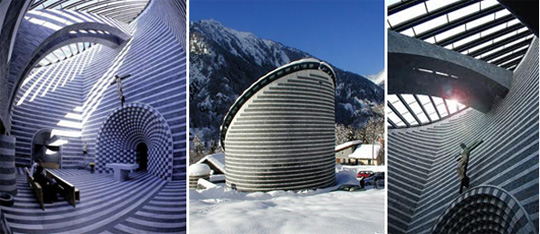
This innovative building has become a landmark, known well beyond Switzerland’s borders. Its most distinctive feature is that it has no openings around its perimeter and is lit only by natural light entering through the sloped glass roof.
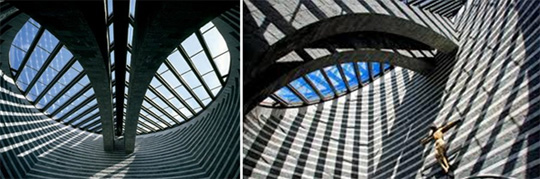
By using only a glass roof, the architect is essentially trying to bring people closer to God. At the same time, the granite and marble, both highly reflective materials, help diffuse the natural light fully throughout the space.
In addition, the church’s designer seeks to create an interplay between the arrangement of the stone, the natural light and the shadows (as the photographs show). In this church, Mario Botta used natural light to “photograph” the passage of time and to establish a relationship with the solar system and the different seasons of the year.
Church of St John the Baptist

Architect: Mario Botta
Location: Mogno, Switzerland
Text: Ilias Eliezer (ilias@flashlight.gr)