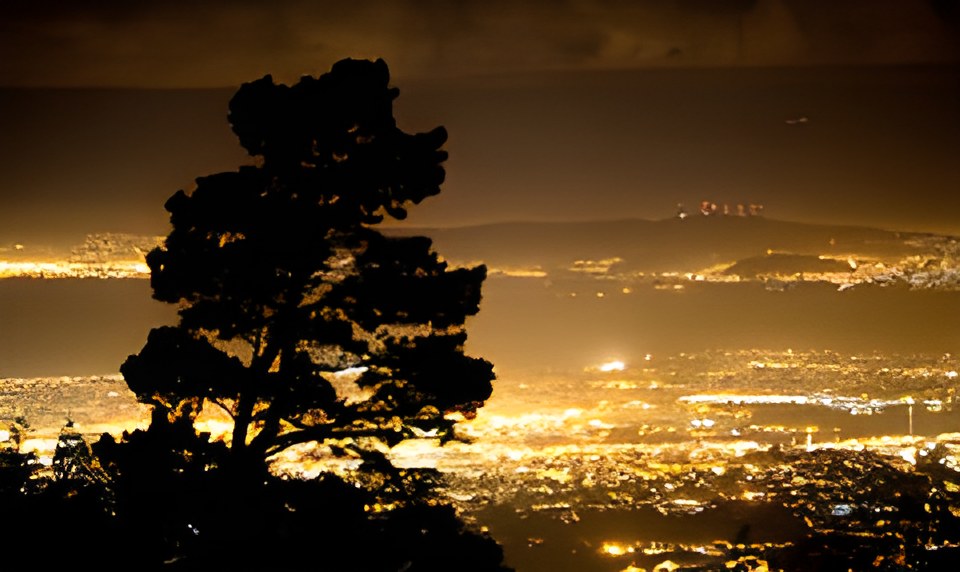
Fewer stars are visible in the sky today. Their glow has been drowned out by the intensity of light sources on Earth. Light pollution is now a serious problem, and not only for astronomers, even though they are the ones most bothered by it.
“I think it’s very important to be able to see the stars,” says space expert Heather Couper on the BBC programme One Planet.
“What light pollution does is wipe out the landscape above us. Imagine if you lived on Venus, which is permanently covered in cloud. You would never see the stars. You would be confined to the landscape around you.”
The good news
A large part of the light produced on Earth is wasted, escaping out into space. In terms of energy consumption, this is not very efficient. In addition, about half of the light bulbs in homes across the planet are incandescent lamps. Only 5% of the energy they use is actually converted into light. The other 95% is wasted.
Paul Wade of the International Energy Agency (IEA) says that the current situation is very poor. “We estimate that around 19% of all electricity is used for lighting in one way or another,” he said. “To put that in perspective, it is equivalent to all the power generated by nuclear and hydroelectric plants, plus another 15%, for lighting applications alone.”
The IEA projects that the energy demand for lighting will increase by about 80% between now and 2030, unless efforts are made to save energy and improve efficiency. However, Mr Wade added that “the good news is that common lighting practices achieve very little in the way of savings, which means that a lot can be done to get the same results with less energy.” Indeed, a major advance in lighting technology is believed to be not far off.
The most recent advances are diodes, or LEDs, which are developing at a rapid pace. Because individual LEDs are so small, they can be placed in efficient optical systems that direct the light.
“With conventional lighting equipment, a lot of the light you want to direct at a building often misses it and escapes into the night sky,” says Mike Simpson, technical and design director of the lighting division of the electronics giant Philips. “Because LEDs are so small, we can put them into very efficient optical systems, which means the wasted light doesn’t disappear entirely, but is greatly reduced.” Mr Simpson said that overall, this reduction can reach at least 50%.
Over the past five years, Philips has invested around 400 million euros in “green lighting technologies”. It now estimates that replacing all conventional light bulbs in Europe with new energy-saving lamps could cut carbon emissions by 28 million tonnes a year, the equivalent of 50 million barrels of oil.
But even greater savings can be made if light is used in a more selective and controlled way. According to Paul Wade, this means learning to make better use of natural light and knowing when to switch off artificial lighting. “There are many ways to use natural daylight more effectively, including technologies that would automatically reduce the light levels of luminaires when natural light levels rose.”
“There are also sensors that can detect when people have left a space and switch off the lights.” Meanwhile, Philips is promoting an automated lighting control system that is on when people are in the space and switches off automatically when they leave. “We estimate that by using very basic lighting controls in an office, you could probably save 50% of the energy,” says Mr Simpson. “We have all walked past office buildings in the city and seen the lights on all night. It’s completely unnecessary.”
Source: BBC
Text editing
Dr Spyros Kitsinelis
Light source research and development
Ehime University, Japan
Author of the book Artificial Light Sources