The hill of the Acropolis rises above the city of Athens and is home to some of the most important cultural monuments of humankind.

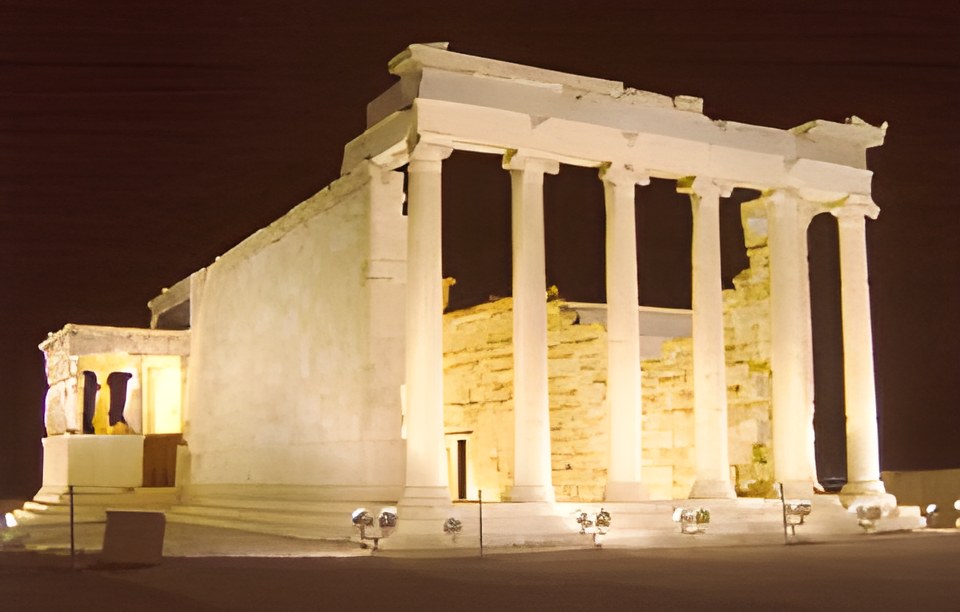
By day, the orientation of the monuments makes full use of sunlight to bring out their unique architecture, while their position shields them from the city lights at night. For many years, therefore, lighting the whole of the Acropolis rock and its monuments has been considered essential, so that the perfection of the ensemble can be displayed.
Modern technologies and building lighting products allow us to light the monuments of the Acropolis more effectively. Even so, the entire site of the Acropolis monuments has been designated a World Heritage Site, and any intervention to install the luminaires that will showcase it must follow a set of extremely strict rules, so as not to alter the appearance of the monuments or cause them the slightest damage.
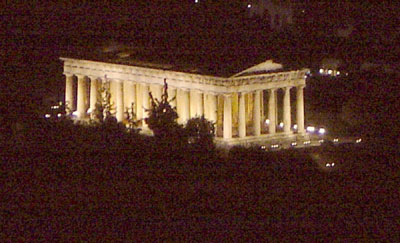
The association “Friends of Athens”, chaired by the film director Michael Cacoyannis, who was the first to envisage lighting these monuments as they deserve, took on the funding of all the necessary studies for the night lighting of the monuments of the Acropolis (the Parthenon, the Erechtheion and the Propylaia), the Odeon of Herodes Atticus, the Temple of Hephaestus (Thiseio) and the Filopappou Monument. To achieve this, it secured the services of the renowned French lighting designer Pierre Bideau, known for the spectacular lighting of the Eiffel Tower in Paris and of many other monuments, who drew up the proposals and selected the type of luminaires to be used.
Subsequently, the Mechanical and Electrical Studies Department of the Doxiadis office, and personally its Director Kostas Kapos, Mechanical Engineer, M.Sc. and member of the Hellenic Illumination Committee, undertook the implementation design, based on Bideau’s artistic proposals. The design covered the following:
1. Determining the exact positions of the floodlights on the monuments so that they would not spoil the appearance of the façades, given that the floodlights selected were quite bulky. For the same purpose, Mr Kapos requested a special colour specification for the floodlights, ordered specially from the Philips factory in France (floodlight colour RAL 9001).
2. Designing special stainless steel brackets for the floodlights, so that there would be no risk of any damage to the monuments. The brackets had to be aesthetically acceptable, not visible from a distance, not anchored at any point on the monuments, movable, and able to withstand wind loads at wind speeds above 160 km/h.
3. Determining the cabling for the floodlights, given that all the cables would have to run in plain view and without any fixing.
4. Circuit supply and switching automation, so that distribution boards located far apart from one another could be switched on by wireless remote control. 5. Drawing up specifications and presenting the design for approval by the Central Archaeological Council.


As mentioned above, there could be no permanent intervention, damage or alteration to the features of the Acropolis monuments, which are part of the world’s cultural heritage. The lighting installation for the monuments as a whole therefore had to meet the following conditions and rules, as set out by K. Kapos:
1. There must be no excavation. Only the temporary covering of some cables with loose, friable soil, strictly at surface level, is permitted.
2. All cabling will be surface-run, and the cables will not be fixed to the architectural elements by any permanent means.
3. Wherever possible, cabling will be hidden behind various architectural elements so as not to alter the appearance of the monument.
4. The luminaires will be mounted on movable bases that can be removed or relocated.
5. The materials used will not oxidise and will not cause stains or other chemical reactions with the architectural elements of the monuments.
6. Because the lighting is surface-installed, all cabling and luminaires will be located in places inaccessible to visitors to the archaeological site.
7. Although temporary, the mounting of the luminaires must be sufficient to withstand various mechanical stresses that could knock them over (vibration, wind loads, accidental kicks, etc.).
8. In the future, once conservation work on the monuments has been completed, the external luminaires must be able to be reinstalled on any future metal fencing around each monument, if the competent Archaeological Service finds this acceptable.
What distinguishes this design from the methods used to light the monuments until now is the use of far lower-powered floodlights, each of which lights a particular architectural element in its own way so that the relief can be read from a distance. In addition, the interior walls are lit in a way that creates the impression of an inner light coming from the monuments themselves rather than falling on them. Three basic types of floodlight were therefore chosen:
? Metal halide floodlights with a ceramic burner (Philips CDM-T type), colour 830 and colour temperature 3000 K (natural white), in 35, 70 or 150 W.
? High-pressure white sodium floodlights (Philips SDW-T type) with a colour temperature of 2500 K (off-white/yellow), 100 W.
? Wide-beam high-pressure sodium floodlights (Philips SON-T comfort type) in 100, 150 and 250 W, with a colour temperature of 2200 K (pink-orange).
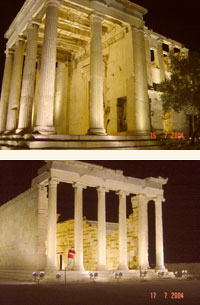
The first two types of floodlight were used to light the architectural elements of each monument (columns, metopes, pediments, etc.) and specific external walls. To create a more striking effect that emphasises the relief, one of the first two floodlight types was used on each column, so that each visible quadrant is lit by a different type. The beams were focused with special glasses/lenses (horizontal or vertical spreaders), so that the beam runs vertically along the length of each column, or horizontally along a metope. Some floodlights even required sandblasted protective glasses to give a perfectly uniform lighting effect on walls.
The third type of floodlight was used to light the interior walls of each monument (the cellae), so that the relatively low light level and the orange colour give the impression that the wall itself is glowing with an inner light, symbolising the ancient spirit that lives within these monuments. The general philosophy adopted was that, when these monuments were built, their likely lighting was fire, so lighting of a similar kind is the most fitting for their architecture.

Besides the lighting of the monuments, the lighting of the Acropolis Rock is also of particular importance. Until now, the Rock was lit by wide-beam high-pressure sodium floodlights, which once again meant that its relief could not be perceived, even though, together with the wall above it, it is a monument in its own right.
Here again, type 1 floodlights with a medium-wide beam are used, striking the rock and the wall at an angle, so that on the one hand the area’s ecosystem, which includes hawks, owls and other birds of prey, is not disturbed, and on the other the relief of the sacred Rock and the Acropolis wall is emphasised. Particular care has been taken at all the monuments to ensure that the floodlights or their beams are not visible from afar, only the lighting effect they produce on the monuments. For the south side of the Rock in particular, which has far less relief than the north, sandblasted glasses were used again, so that the Rock would not become brighter than the monuments themselves.
In total, the contractor J&P ΑΒΑΞ installed about 800 floodlights to light the monuments, yet the power drawn has been reduced considerably compared with the previous floodlights, which were rated at 400 or 1000 W each and gave an extremely ineffective lighting result for such important monuments. It is worth noting that both the Filopappou Monument and the Temple of Hephaestus (Thiseio) were lit for the first time since they were built, and the result was described as outstanding.
Mr Bideau and Mr Kapos also took part in supervising the execution of the project (Mr Kapos had overall direction of the works and made extensive changes to Bideau’s proposals, where required by the Archaeological Service or for a better lighting result), and they provided substantive, immediate solutions to problems arising during construction so that the monuments of the Acropolis could be lit during the Athens Olympic Games. It is telling that both engineers worked for many days until 5.00 every morning, often climbing the flanks of the Sacred Rock, in order to aim the beams of the floodlights precisely themselves.
The same engineers also drew up the lighting designs for Lycabettus Hill (works there are under way), while designs are ready for implementation for the Temple of Olympian Zeus, the archaeological site of Eleusis, Hadrian’s Gate and the Herodeion. Mr Kapos is the representative in Greece of the office CIEL Pierre Bideau SA, and his achievements include (among many others) the installation of the stroboscopic effect “Olympic Meteor” on the south slope of Lycabettus during the Olympic Games.