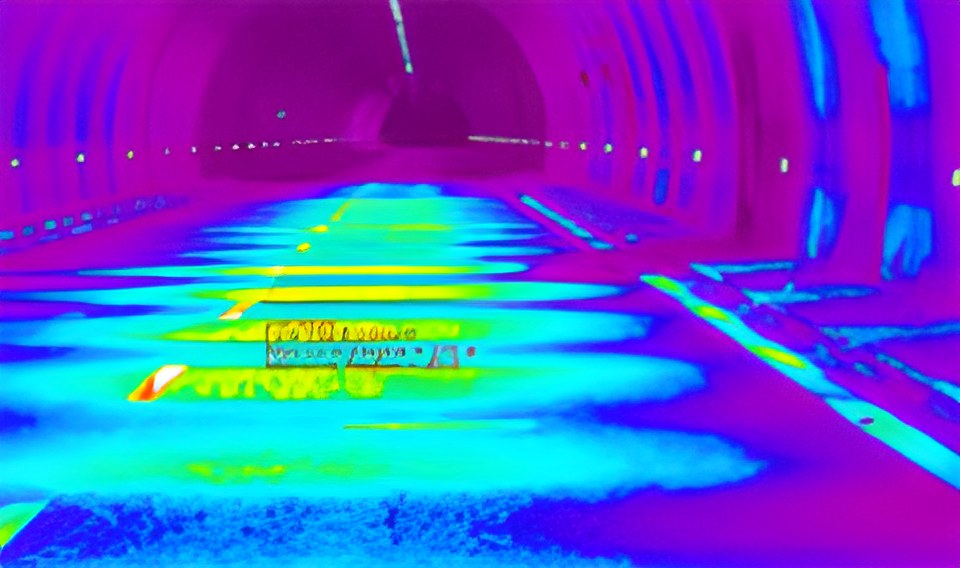
Checking the lighting of roads and tunnels is an important factor in both road safety and energy saving. International standards require quality control of lighting through measurements of road surface luminance. The traditional method involves taking measurements point by point at discrete locations within an area of the road surface, using an analogue instrument. In recent years this time-consuming procedure has been partly replaced by digital cameras that record luminance images. Both methods require traffic to be interrupted, and both are difficult to prepare for and to process the resulting images.
For this purpose, a system (Figure 1) was developed that is mounted on a moving vehicle and takes automated captures from the position of a typical driver (1.5 m). It minimises preparation and processing time, and its use has very little impact on road traffic. It consists of a digital sensor, calibrated in photometric units, which feeds an algorithm that recognises the traffic lane and the road surface. Processing the image yields the relevant quantities and lighting quality indicators directly. The measurement procedure complies with international standards.
The sensor is a board-level CCD, fitted with a special V(λ) filter and a fixed focal length photographic lens.
Figure 1 – Representation of the system: CCD – 1: real image, 2: lens, 3: V(λ) filter, 4: CCD sensor, 5: image processing algorithm, 6: final array (image) of photometric quantities.

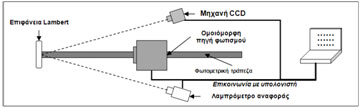
The photopic V(λ) filter gives the CCD sensor the spectral sensitivity of the human eye, which is essential for calculating photometric quantities such as luminance. A special methodology was developed to calibrate the CCD sensor, using the experimental setups shown in Figures 2 and 3.
Using a standard luminance source (Figure 2) and repeated measurements at various luminance levels, the output of the sensor was measured and its dynamic range was calculated. The peripheral shading (vignetting) produced by the lens was also calculated and corrected. With the second experimental setup (Figure 3), the deviation of measurements on targets lit by light sources with different spectral distributions was measured, and the appropriate correction factors were calculated. The calibration procedure produced the transformation matrices needed to convert the sensor’s images into luminance images.
Figure 2 – Experimental setup for CCD sensor calibration
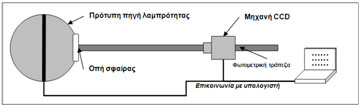
Figure 3 – Experimental setup for CCD sensor calibration
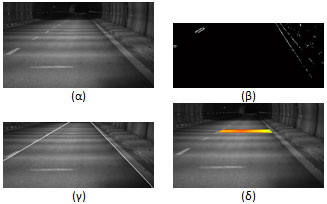
The road surface recognition algorithm, for its part, takes a copy of the original image and processes it in real time in order to isolate the section of road surface on which the measurements are to be made. Sharpening and edge-detection filters (4b) are applied to the original image (4a). The Hough line transform is used to search the image for straight lines, and those corresponding to the traffic lane targeted by the capture system are selected (4c). The required measurement distance (60 metres from the capture point, according to the standards) and the length of the measurement area are then calculated. The desired “trapezoid” of road surface (4d) is isolated from the original luminance image, and from it all the required lighting quality indicators are calculated, such as average, minimum and maximum luminance, various uniformities, and so on.
Figure 4 – Representation of the image processing algorithm.
As the vehicle carrying the system moves, the images for each section of road are measured and analysed at the same time. For example, in a road tunnel, a single pass of the vehicle produces the lighting profile along its length in real time, and its quality indicators are calculated in accordance with the standards.
K.A. Barousis, A.I. Travlou-Soult, F.V. Topalis
NATIONAL TECHNICAL UNIVERSITY OF ATHENS
School of Electrical and Computer Engineering, Lighting Laboratory
Downolad Poster A0 – Road and tunnel lighting measurements using an imaging system