We hear about the effects of lighting on people’s emotional state, and we surely find ourselves asking how this can be, what it is that affects us, and why a space feels pleasant or unpleasant depending on its lighting.
For every question about lighting there are common-sense answers, as well as others that have emerged from long-term research and studies designed to prove them.
Lighting design is the result of combining art and science. It demands technical knowledge and constant attention to developments in technology, but above all an understanding of the aesthetics and needs of the people who use the space. I would describe it as art made to order!
A study by InformeDesign analysed people’s behaviour when exposed to different kinds of lighting.
It reports that:
– people orient themselves better, subconsciously, in spaces with horizontal and vertical “strips” of light, especially where these intersect at some point.
– when they have to choose a route, even inside a building, they always follow the brightest path.
– the brightest points in a space are the ones that draw their attention. – they prefer to face illuminated surfaces and walls.
– and, as a consequence of the above, lighting affects the position and posture of their bodies.
In another experiment, carried out years ago, Dr. John Flynn developed a theory that defined the criteria for evaluating the lighting of a space.
As part of this research, he gathered information from participants, who were asked to describe spaces combining uniform or non-uniform lighting, high or low intensities, and perimeter wall lighting or ceiling lighting.
He concluded that, taken together, the users’ responses would describe a space as:
– pleasant or unpleasant,
– public or private
– spacious or cage-like
– relaxed, restful or tense
– visually clear, or hazy, dull and gloomy.
APIVITA store, lighting design: Dimitris Nasikas

Users described as pleasant the space with non-uniform lighting at various intensities, coming from the perimeter rather than the ceiling.
Athens International Airport – Eleftherios Venizelos

The space with uniform, diffuse lighting at higher intensity levels, with the sources in the ceiling, was described as public.
Clothing store

The space with uniformly high light intensity at every point, on every surface and wall, was described as spacious.
Residence, lighting design: Dimitris Nasikas
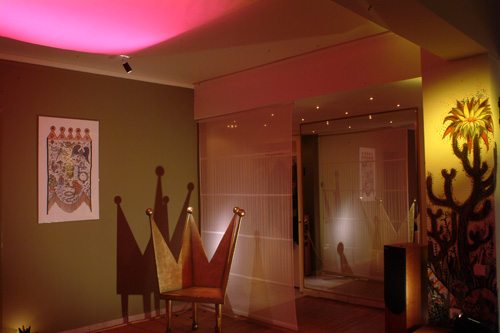
The space with non-uniform, diffuse, low-level perimeter lighting was relaxing.
Finally, the space with high intensities of mainly perimeter lighting, especially in the areas where people carry out their activities, was described as visually clear.
Another finding, which has been proven and is now a rule in the methodology of lighting a space, concerns the relationship between light levels and the expected cost of the products or services offered there.
Specifically, a lighting approach with high light intensities, which the study’s respondents would describe as public, gives us the impression that we will find affordable options there. It brings to mind typical, inexpensive shops crowded with people.
Compared with that picture, specialist shops with low light levels predispose us to expect more expensive products and services.
Notice what you expect to pay when you visit a restaurant. The lighting atmosphere will help you sense it, before you have even seen the menu.
Knowing, then, how the lighting of a space affects people’s expectations and feelings makes it one of the most important factors in fulfilling the owner’s intentions and meeting the needs of its users.