flashlight.gr is launching a new series of features on the lives and work of great designers of lighting, both contemporary and from earlier eras. The aim is to build a database that allows readers, by piecing it together, to travel through the history of lighting design. The new series opens with a presentation of the great visionary Joe Colombo by Markos Vouzounerakis.
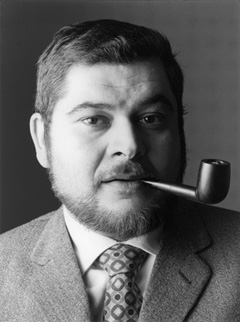
Joe Colombo: The visionary of the future
Ceasar (known as Joe) Colombo was born in Milan on 30 July 1930. Although self-taught, he attended the Brera Academy and, for a few years, the school of architecture at the Politecnico di Milano. Before becoming a designer, he painted alongside Enrico Baj and Sergio Dangelo (the brother of Gianni, still a painter), and worked as a property developer, as a car salesman (cars remained a lifelong passion) and as an industrialist in the electrical sector, taking over the family business after his father’s death. His specialist knowledge in this field proved particularly useful in his later work as a lighting designer.
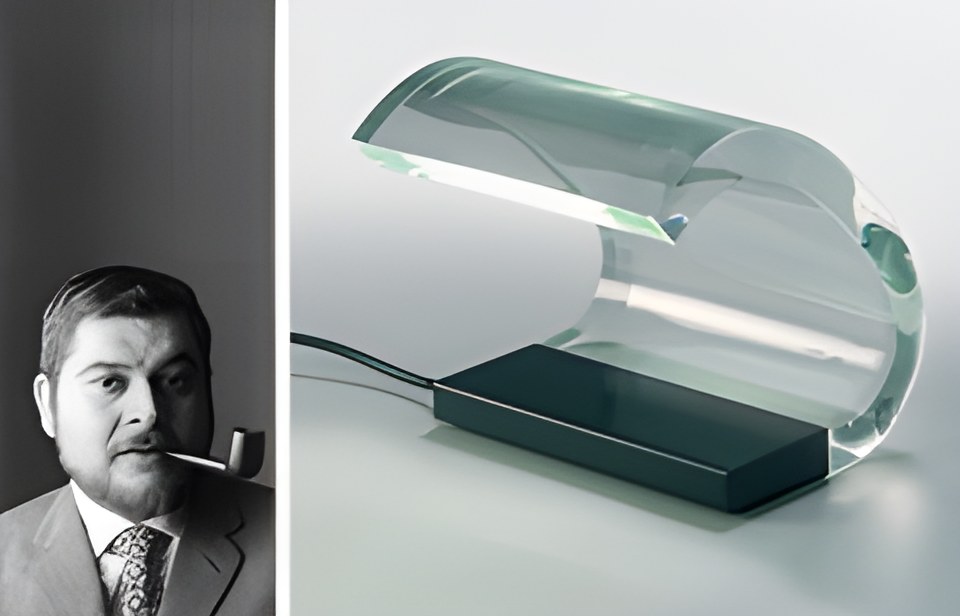
Tall, well built and an avid pipe smoker, at first with a moustache and later with a Cavour-style beard, he opened his first studio in Milan in 1963. A year later he won three medals at the XIII Triennale (gold for the O’Luce Acrilica lamp, silver for the Benini Combi Center and for the Mini Cucina Boffi). In 1967 the Spider, again for O’Luce, won him the Compasso d’Oro, an award he won again in 1970 with the Spring. Both were designed for O’Luce.
By 1969, the year he designed the futuristic Visiona Interior for Bayer in Cologne, three of his creations were already part of the MoMA collection in New York. For the decade’s legendary exhibition “Italy: The New Domestic Landscape” at MoMA in 1972, Colombo designed the Total Furnishing Unit.

It is a work that is the ultimate expression of his “furniture machine-capsule” approach to space. Sadly, Colombo never saw this exhibition with his own eyes. He died suddenly on 30 July 1971, his birthday.
Joe Colombo was one of the greatest designers of the 20th century. A visionary of the future. Throughout his short life he held an unwavering faith in what was to come. Indeed, in the 1960s, when the future suddenly seemed very close, he gave a unique and entirely personal first taste of what would follow. Anti-nostalgic and wholly oriented towards the smart technology that would lay the foundations for modern ways of living, he designed everything as complete, self-sufficient, living wholes: self-contained objects, functional units, life-cells that define a space. Always bold, he took his research to new heights by breaking down the boundaries between art and science, combining pioneering forms with new-technology materials, and imagination with realism.

A vivid example is the legendary Acrilica lamp for O’Luce, an early version of today’s optical fibre. Habits changed quickly in his day, and with them ideas about how to arrange a space. Lighting therefore had to change too, shedding its static quality and its attachment to the centre of the room. It had to acquire a dimension of its own, define the space, and stand in a relationship of constant interaction with people and with the things that surround them in their living spaces. He thus presented an endless series of lighting proposals and luminaires that combined innovation, aesthetic perfection and absolute functionality in a unique way. A hallmark of design completeness is the Spider luminaire for O’Luce, with its specially designed lamp, which paved the way for the manufacture of mirror lamps and marked the start of a new era.

The brief, magical years when the slogan “imagination to power” prevailed were also the brief, magical years of Joe Colombo. No one could say whether this brilliant visionary would recognise himself in the millennium we are living in.
Text: Markos Vouzounerakis