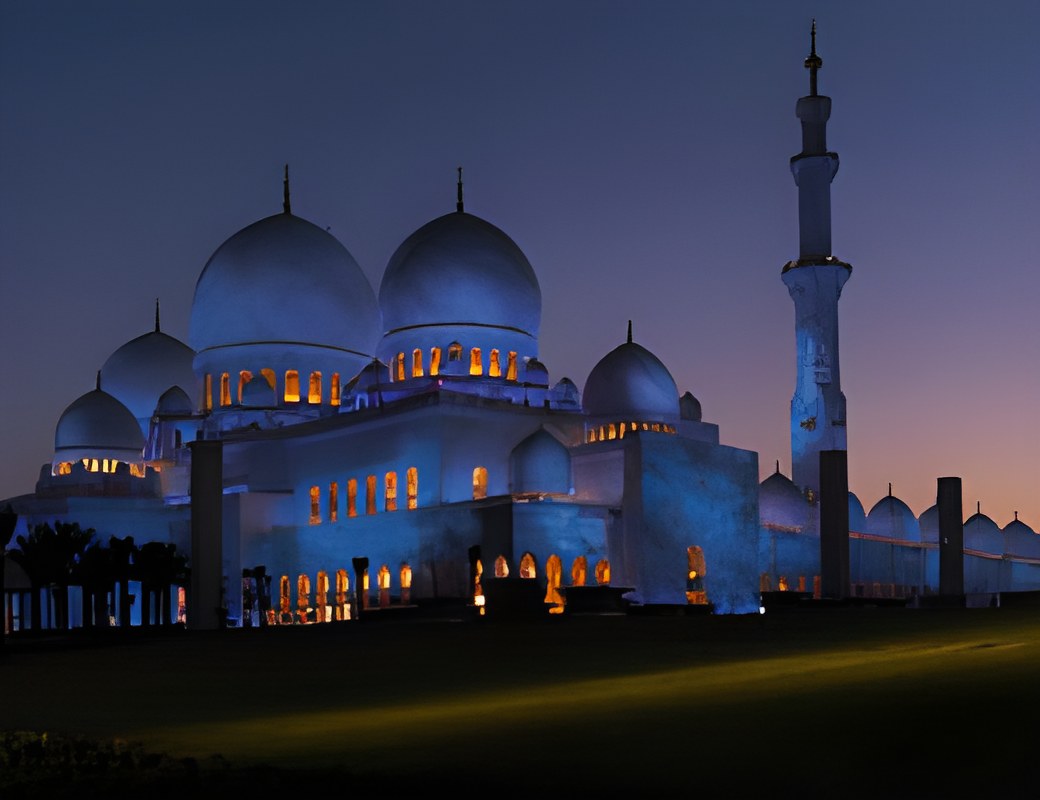
The Grand Mosque is the largest national religious monument built for the people of Abu Dhabi, in honour of their ruler and the United Arab Emirates’ greatest builder, Sheikh Zayed.
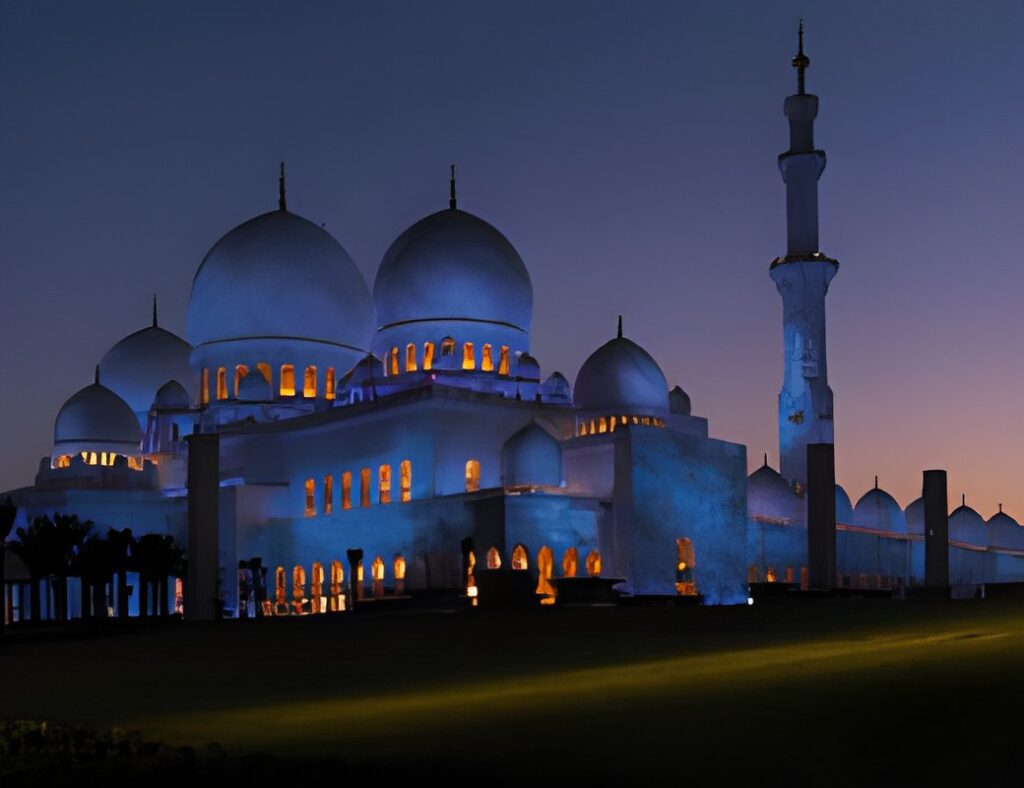
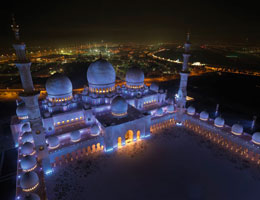
It is built of marble and gold mosaic. Its four minarets rise to a height of 107 metres, while the main dome stands at 80 metres. The building’s total area exceeds 22,000 sq m, making it the third largest mosque in the world and one of the religious landmarks of the planet.
Given the monumental stature of the mosque and the awe it inspires, the Abu Dhabi Municipality and Agriculture Department sought a lighting design that would convey its cultural identity and tie it to its history.
“The approach we decided to present linked the exterior lighting to the lunar cycle, which is closely associated with Islamic tradition,” explains Keith Bradshaw, director of Speirs and Major Associates, the practice responsible for the lighting design. “So we used the cycle of the moon as inspiration to connect the building to the sky, so that the mosque reflects every movement of the moon. When the moon is full, the mosque will have a grey-white light, similar to the faint light we receive on earth from the moon. Each day, as the moon takes on a golden colour like melted wax and its brightness gradually diminishes, the mosque will become darker and bluer, reaching the new moon with the building in its bluest tones. In addition, we use the enigmatic atmosphere of the clouds to add another “layer” of light, reinforcing the idea that the building is a reflection of the moon. The building shows a high level of religious refinement, but it is also of great urban significance. It sits on a plateau looking up at the sky, with nothing else of the same scale around it, which gives it something quite exceptional.”


One of the project’s many challenges was to create balanced lighting, with good emphasis and a clear rendering of texture and detail, on such a large scale. All the façades, domes and minarets are lit with beams from Martin floodlights.
The installation included more than 400 Martin image projectors, around 500 floodlights, 248 recessed luminaires, 200 in-ground luminaires and various other fittings. The quality of the luminaires and their ingress protection rating were an important factor in an environment where summer temperatures typically reach 50°C.
The control system was supplied by ETC through its Middle East distributor, Oasis Enterprises, which provided 21 Congo Light Servers, 15 Unison processors, 17 custom-built equipment racks and 52 dimmer racks, containing almost 2,300 circuits. The current status is logged, with a database recording any faults and any data that need processing, in order to provide feedback to the building’s operating system.
Once the project was complete, Mr Bradshaw said: “It’s interesting that although the project was designed in 2005, there are very few technologies we would change. We looked at various LED solutions while the design was being refined, but performance and cost ruled them out. In many cases we have used very simple lighting solutions, but the composition and balance of the effects were studied very carefully to achieve the best result. I can’t say I’ve seen a new technological solution that I think we’ve missed or that could have helped.”
Interview with Jonathan Speirs (Speirs and Major Associates):
Information: Mondo arc
Photographs: Allan Toft, Martin Professional
Text: Giorgos Bilios, Manos Lianopoulos