While the brightness level (dimming) of a light source is one of its characteristics that can be controlled and adjusted, other characteristics, such as colour temperature and colour rendering index, are fixed and unchangeable, so the appropriate lamp is chosen for each application.
Dynamic lighting, that is, the creation of an atmosphere to suit a person’s activity or mood, is an area on which the major lighting companies have concentrated their efforts.
Dynamic lighting with multi-source luminaires.
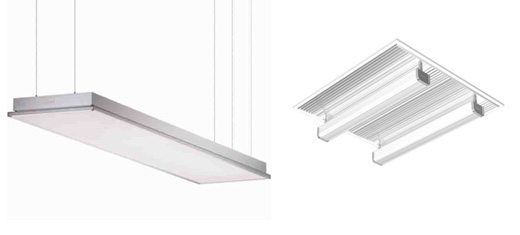
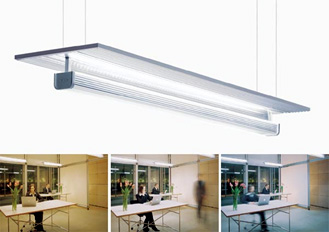
Some products already on the market allow the colour temperature to be selected. These products use multiple light sources, some producing warm white light, that is, light with a low colour temperature, and the rest producing cool light. Selecting the brightness level of each source also makes it possible to select the overall colour temperature of the luminaire. For example, an overall cool white light can be chosen for work that demands particular concentration, while a warm light gives a more relaxed atmosphere in which people can unwind and calm down.
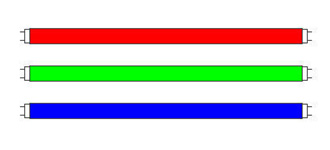
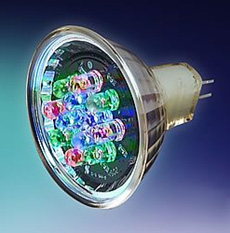
Likewise, by using lamps that cover the primary colours (red, green and blue), a multitude of colours can be created, giving a very wide range of options for lighting a space.
To create all the colours, three lamps are used in a single luminaire.
The drawback of using multiple light sources to create atmosphere is that expensive optics are needed to diffuse the emitted light evenly, and this usually means losses of up to 50% of the light produced. Fluorescent lamps are the type mainly used in atmosphere-creating products, although multiple LEDs or incandescent lamps with suitable filters could also be used. Another popular application of these products is in spaces without natural light, where they can simulate sunlight and the changes in colour temperature that take place over the course of the day.
Dynamic lighting with multi-source luminaires.
Various efforts are under way to create luminaires that offer a choice of colour temperature using only a single source.
One idea is to use two different phosphors in the same discharge tube and to excite them selectively by changing the lamp’s mode of operation, and consequently the radiation emitted by the active medium. Switching the current supply from continuous to pulsed, for example, affects the relative intensity of the mercury emission lines, and different lines can excite different phosphors. On the same principle of changing the mode of operation, it is possible to choose which of two different active media with different energy levels is excited (or between an active medium and a buffer gas), and these in turn can excite different phosphors.
Another idea is to vary the current intensity in order to separate mixtures of active media through the phenomenon of cataphoresis, a technique used in both low-pressure and high-pressure (HID) discharge tubes.
Pulsed operation.
The use of pulsed current has opened up new horizons in light source research, and some of the new ideas are already making their way into new products.
For a discharge tube of a given power, changing from a continuous supply of electrons to the active medium (whether of single or alternating polarity) to pulsed operation means changing the mean energy of the electrons, since the power during the pulses has to reach high levels (in both voltage and current) for the mean power to stay the same. This change in mean electron energy, which shifts to higher levels, has a significant effect on the emission spectrum of the source.
Applied voltage waveforms for continuous and pulsed operation of a discharge tube.
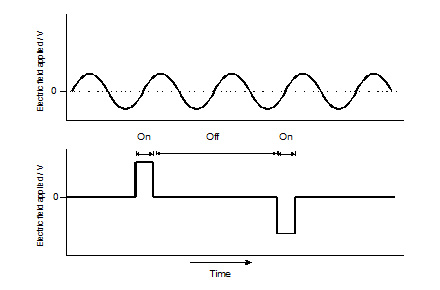
Let us consider the case of mercury, which is found in the majority of commercial lamps for general lighting.
The emission spectrum of mercury under continuous power (direct or alternating current) in a low-pressure discharge tube is well known: the resonance line at 254 nm dominates, and it is this line that excites the phosphors, resulting in the emission of visible light.
When the discharge tube is operated in pulsed mode (pulses lasting a few microseconds, at a frequency of a few kHz), the mean energy of the electrons increases. As a result, the degree of ionisation of the mercury atoms rises, as does the degree to which they are excited to energy levels higher than that of resonance. The spectrum shows emission lines in the near ultraviolet (313 and 365 nm) and the visible range, with increased relative intensity at the expense of the resonance line. This intensity ratio can be controlled by controlling the duration or frequency of the pulses. One application of this is to use emission lines closer to the visible range (where pulsed operation raises their intensity to significant levels) to excite the phosphors, with the aim of reducing Stokes losses.
Another application is to use two different phosphors, each sensitive to a different emission line (for example, one phosphor sensitive to the 254 nm resonance line that dominates the spectrum under quasi-continuous current supply, and another sensitive to 365 nm, which dominates under pulsed conditions). Switching the discharge tube’s mode of operation and adjusting the pulse duration or frequency would also make it possible to control the emitted light (changing the colour, or the colour temperature of white light).
The text is an excerpt from the book Artificial Light Sources by Dr Spyros Kitsinelis.