The video is a documentary showing how the study was carried out, along with some of the results.
Music: 37hz – Embrace
Narration: Manos Lianopoulos
The starting question
The evolution of LED technology is dramatically changing the lighting industry. Lamp and luminaire manufacturers are now building all their know-how and investment around this sector, while the replacement of older technologies in the name of lower energy consumption drives a significant share of commercial activity in lighting. LED technology undeniably has a number of advantages over conventional light sources when it comes to energy consumption. But what about the quality characteristics of the light?
To what extent can LED lamps replace older technologies?
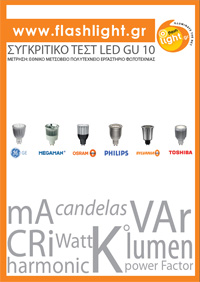
This question inspired flashlight.gr to carry out a comparative test of a cutting-edge, commercially leading product from 6 major lamp manufacturers.
The reference sample: the lamp chosen
The reference sample from the previous technology was the GU10 MR16 36° 50W halogen lamp. It is a mass-market lamp, used in both professional and domestic lighting. The halogen lamp has a fixed colour temperature of 2800 Kelvin, its most common beam angle is 36°, it can be dimmed, and it operates at 230V.
The lamps that took part
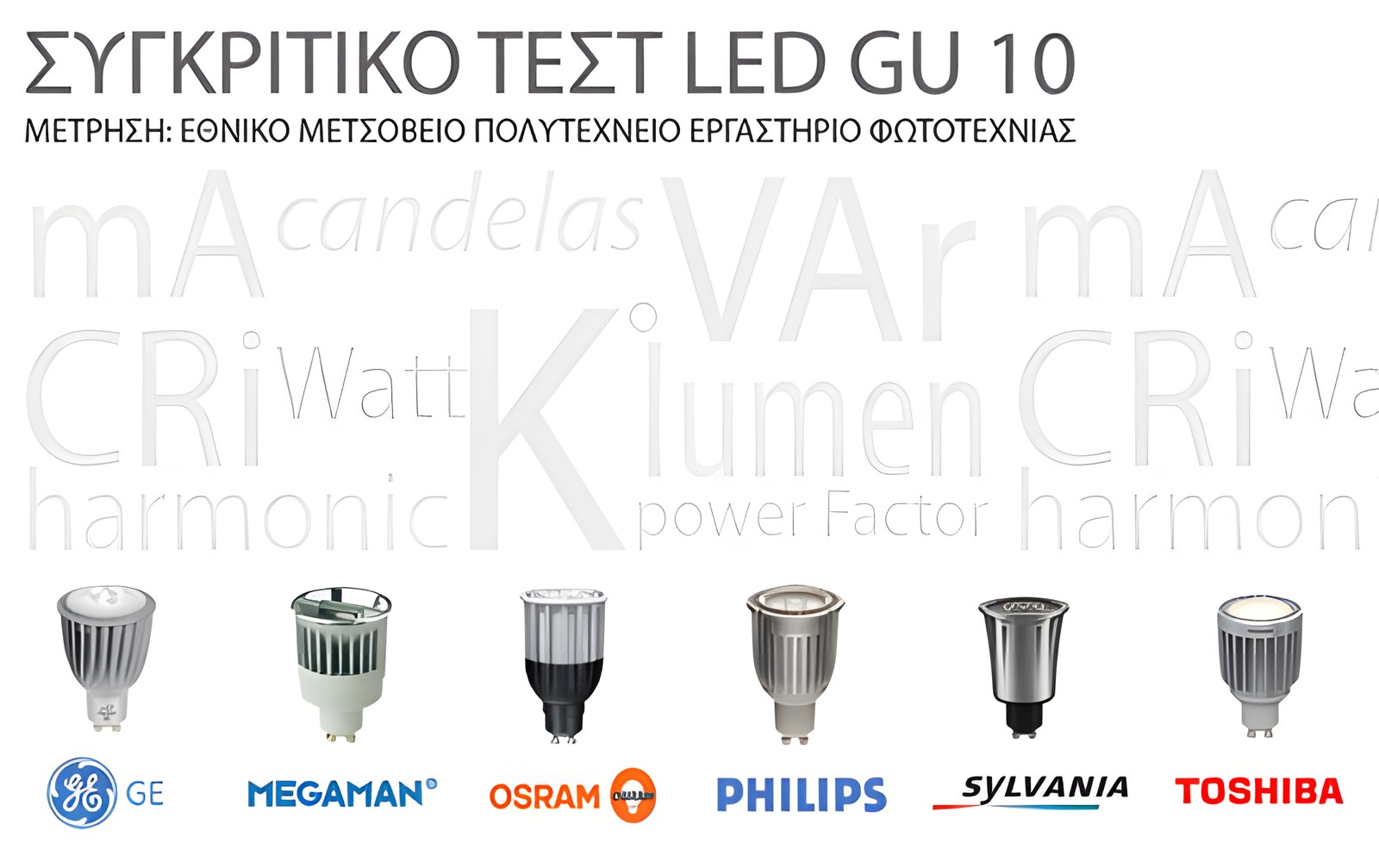
The lamps in the comparative test come from the well-known brands that offer, on the Greek market, a dimmable GU10 lamp capable of replacing our reference sample.
The companies selected are
(listed in alphabetical order):
GENERAL ELECTRIC, MEGAMAN, OSRAM, PHILIPS, SYLVANIA, TOSHIBA
The laboratory that carried out the measurements
The Lighting Laboratory of the Department of Electrical Engineering at the National Technical University of Athens (NTUA) was chosen to carry out the measurements because it is the best-equipped lighting laboratory in Greece and one of the most complete university laboratories in Europe. In addition, both the university status of the laboratory and the standing of its director, Professor Frangiskos D. Topalis, gave the test the impartiality we wanted.
We would like to warmly thank, individually and together as a team, the following people for carrying out the laboratory measurements:
Frangiskos D. Topalis
Konstantinos Bourousis,
Lampros Doulos,
Evangelos-Nikolaos Madias
The characteristics measured
To ensure the reliability of the measurements, three samples of each lamp type were delivered to the laboratory, of which two were measured. The extra one was there in case of large deviations between the two samples (this did not occur in any measurement).
Before the test, we contacted all the companies included in the measurements and informed them of our intention to carry out a comparative test on the lamps in question. GENERAL ELECTRIC, MEGAMAN, OSRAM, SYLVANIA and TOSHIBA kindly supplied us with the three samples of each lamp type needed for a reliable test. We bought the three PHILPS lamps on the market, guided by the type the company recommends on its packaging as a replacement for our reference sample.
The lamp characteristics we asked NTUA to measure are:
• Luminous flux (lumen)
• Maximum luminous intensity (candela)
• Colour temperature (K)
• Colour rendering index Ra / CRI
• Luminous efficacy (lm/W)
• Active power (W)
• Power factor
• IEC harmonic distortion (%)
• Current (mA)
• Reactive power (VAr)
• Dimming behaviour.
In addition, to give a complete picture of the comparison, we will also provide the following information:
• Lamp dimensions.
• Warranty offered by the companies.
Unfortunately, we could not obtain results for the lifetime or the number of on-off cycles of the lamps, because there are no laboratory conditions for artificially ageing LED technology, and none are applied in any laboratory worldwide, so reliable results cannot be obtained within a reasonable period of time.
The tables presented compare the samples in three ways:
• A comparison among the samples from the six companies.
• A comparison among the samples from the six companies and the characteristics of the reference sample, the 50W halogen.
• A comparison between the laboratory measurements and the figures published by the companies.
Download the NTUA measurement results prepared for flashlight.gr
Click here to download the full study as a PDF (1.4 MB).
Click here to download only the study’s results tables as a PDF (12 MB).
Editorial supervision and data processing: Miltiadis Psyllias
Production management: Manos Lianopoulos