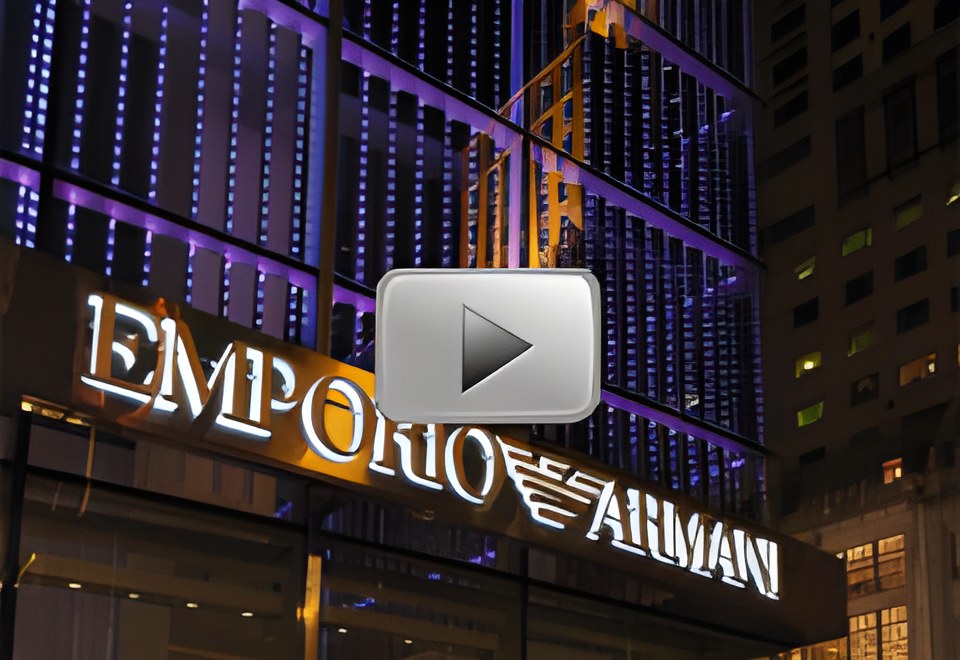
The famous Italian designer’s new store on Fifth Avenue in New York may have opened its doors to the public last February, but its look has only now been fully completed, with the installation of the Martin LC Plus LED video screen on the façade.
The lighting of the store was entrusted to Speirs and Major Associates, who have worked with Armani before. This is why the new store was seen as a major challenge: Speirs and Major Associates wanted to surpass the result they had achieved in the designer’s Tokyo store in 2007. The big “bet” was that the lighting had to match that of all of Armani’s stores, yet be even more striking.
The firm followed the basic lighting principles for stores of this kind, but here it was the details that made the difference…
The central idea was a discreet lighting scheme that would not draw the eye, since the stars of the show here are Armani’s creations. With this in mind, they ruled out strong lighting on the white walls, which already contrasted sharply with the black floors, so that customers would feel they were looking at “natural” wardrobes. Likewise, to avoid overshadowing the clothes, they did not light many of the horizontal surfaces.
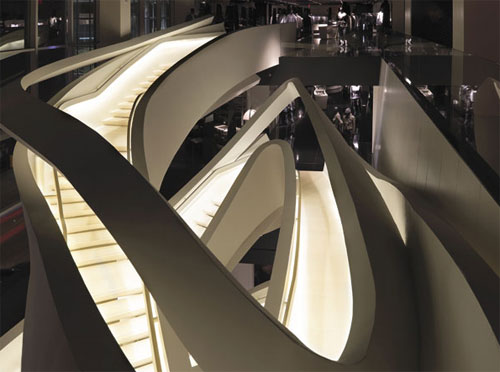
One unique detail is the brightly lit staircase. It was given greater emphasis through a slightly brighter shade of white, so that the circulation route stands out completely from the areas where the clothes are displayed.
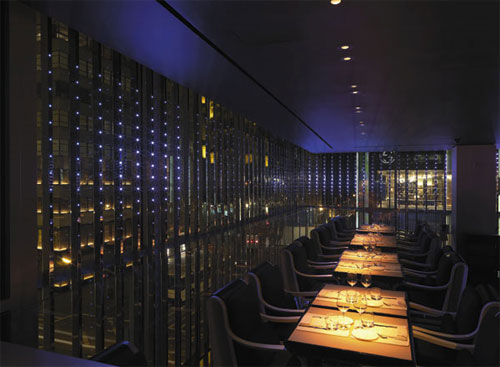
The lighting of the restaurant-bar was also carefully handled. Using LED fixtures arranged like an invisible curtain, they managed to “soften” the light and reduce the intensity of the view in from the street. The LEDs and their cover lenses were also integrated seamlessly into the design of the bar, giving the space a sense of harmony.
The façade
The LC Plus screen was the catalyst for the look of the façade. Its greatest asset is that it lets even natural light pass through it, as it is 60% transparent. The central idea, after all, was for the façade to resemble a transparent box, and the screen’s transparency was the key to achieving that.
The result is unique: the images against the black background seem to flow across the surface of the glass, while passers-by can still see inside the “glass box”.
Of course, the content shown on the screen is just as important as the screen itself. It was therefore decided that the themes would reflect the products and would change every six months, so as to keep pace with fashion and always stay close to the story Armani has written as a designer.
It is worth noting that all the animations were designed so that the shapes and forms in the images remain clearly visible from every angle, even from a long distance.
Project: Armani, New York City
Client: Giorgio Armani
Lighting design: Speirs and Major Associates
Architects: Fuksas Architects
Photography: Allan Toft
Lighting systems:
• Martin: LC Plus LED profiles for facade
• Philips Color Kinetics: iColor Cove MX Powercore (curtain wall)
• Pharos lighting control system
• ERCO: Stella high level mounted spots
• ETC: Source 4s in ceiling recess
• Lucifer: low voltage downlights
• Lutron: Grafik Eye 7000 lighting control system
• National Cathode: cold cathode backlighting to mirrors
• OSRAM: LinearLight self-adhesive LED tape (staircase)
• RSA: custom trough system featuring CDMR111 10 degree lamps to the merchandise
Editor: Maria Georgiadou
Source: Mondo Arc