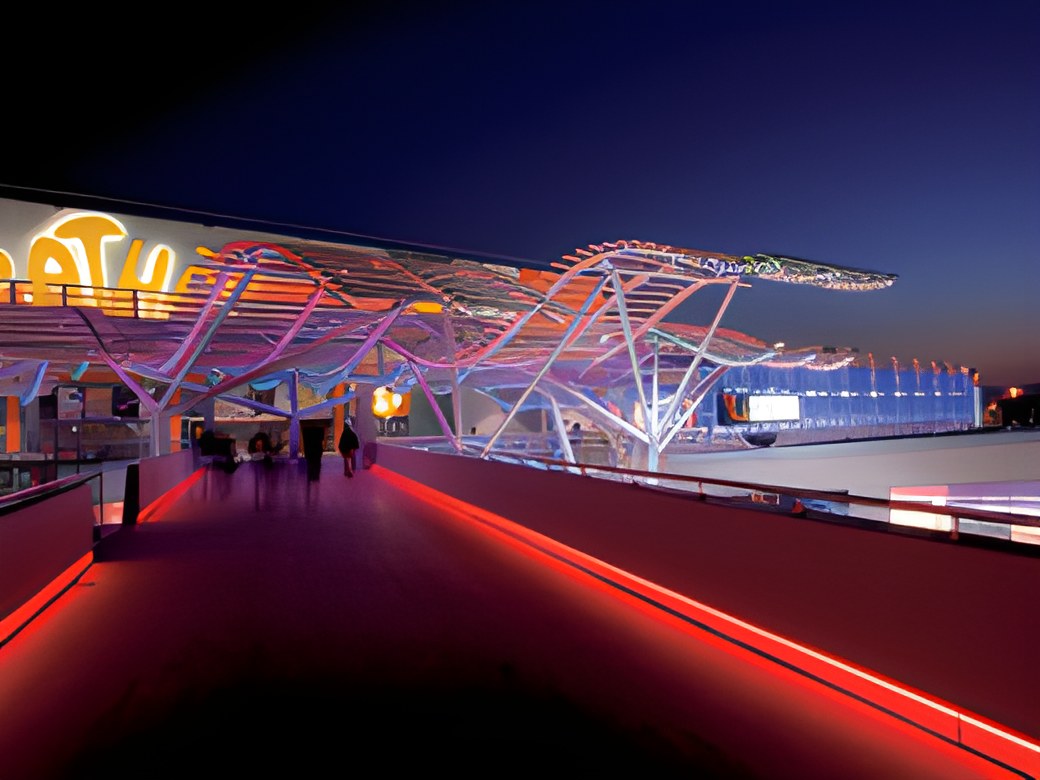
Besides its distinctive architecture, the Carre De Soie complex is brought out by a fully integrated lighting system.
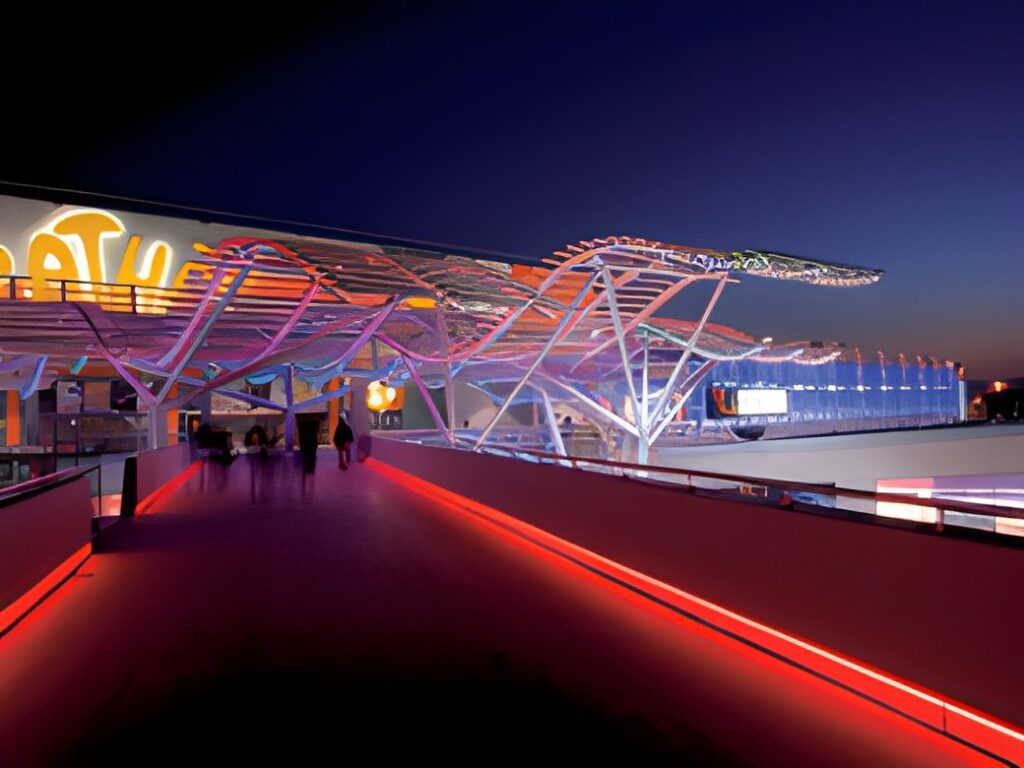
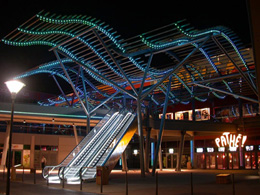
The Les Eclairagistes Associes (LEA) team took on the difficult task of lighting the shopping centre. Laurent Faschard and his team had to meet the functional needs of a building of this kind, such as lighting public areas and the car park, while also showcasing the architecture. They therefore decided to divide the lighting interventions into three strands:
1. Primary lighting, which aims to highlight and enliven the outline of the building.
2. Secondary lighting, which deals mainly with functional matters such as visitor orientation and, with it, safe movement around the centre, and
3. Tertiary lighting, which would complement the other two and be designed to reflect the gleaming materials of the building and its interior structures.
What makes the lighting design special, however, is the way it frames the building’s dynamic form. In particular, a giant canopy extending from the building towards the avenue draws the eyes of passers-by to the structure. At night, from the time the cinema opens, this canopy becomes the “illuminated heart” of the shopping centre. The lighting even intensifies or stays subdued depending on how busy the shops are.
It is a combination of organic and metallic objects, masterfully brought out by the lighting scheme of the LEA designers. The team used Philips Color Kinetics iColor Flex MX LEDs, each consisting of an array of 50 high-intensity coloured LEDs. The iColor Flex MX can create distinctive effects without its use being limited by size or shape. LEA used 490 such arrays to install 16,000 LEDs in the “hanging tentacles” of the metal canopy.
With the help of the Light System Manager, the shopping centre’s managers can create a wide range of light shows, depending on the season or the needs of the shops. The structure can thus produce sparkles of light, bursts of colour, or even the impression of a moving rainbow.
Text: Eleftherios Savvidis
Source: Mondo Arc
Photographs: ZEF & LEA