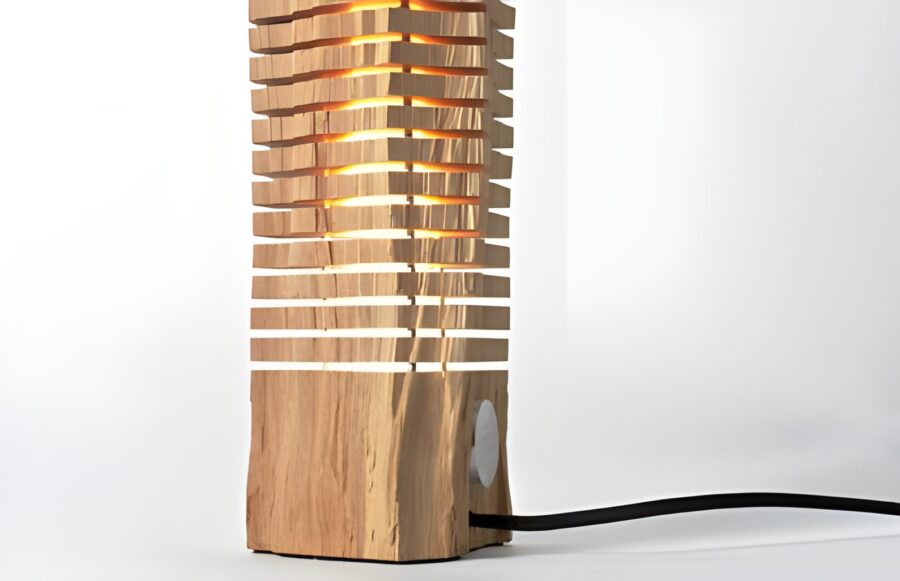
Neon lamps have a wide range of applications: desk lamps, stair lighting, display cabinets, bookcases, picture lighting, cupboards, concealed lighting, signs and so on.
So here is some useful information about neon lighting:
• What makes a luminaire a neon luminaire?
The addition of neon to the glass envelope of the luminaire’s lamp.
• Why is neon added to the other gases inside a lamp’s glass envelope?
The main reason is that adding neon to the lamp’s glass envelope extends its life.
• What is the rated life of neon lamps?
Depending on the lamp, the rated life of a neon lamp ranges from 8,000 to 20,000 hours.

• What do we mean by the rated life of a lamp?
The rated life of a lamp is the time at which 50% of a large sample of lamps of that type have “burned out”. This means that 50% of the lamps will fail before the rated life and 50% after it. Rated life does not mean that every lamp of the type it describes will last at least that long.
• Does the term “rated life” apply to all types of lamp, or only to neon lamps?
The term is standardised and applies to all types of lamp.
• Do neon lamps run at lower temperatures than halogen lamps?
Yes. Neon lamps run at significantly lower temperatures than halogen lamps (on lines of the same voltage).
• Are neon lamps dimmable?
Absolutely. In fact, dimming a neon lamp will increase its average life, even beyond its rated life.
• What type of dimmer should be used with neon lamps?
If the low-voltage neon lamp (12 or 24 volts) is powered by an electronic transformer, the dimmer must be designed to control a low-voltage electronic transformer. If it is powered by a magnetic transformer, the dimmer must be designed to control a low-voltage magnetic transformer. If it is a line-voltage (120 volts) neon lamp, the dimmer simply needs to be a line-voltage dimmer.
• What kind of light do neon lamps give?
Neon lamps have a colour temperature between that of standard incandescent lamps and halogen lamps. Put simply, the light from such a lamp looks cooler than that of an incandescent lamp, but warmer than that of a halogen lamp.
• Do we need to be careful about touching a neon lamp with bare hands?
Unlike halogen lamps, neon lamps can be touched with bare hands without affecting their performance prematurely (i.e. without burning out early). Take care, however: always wait for neon lamps to cool down before touching them.
• Can you replace halogen lamps with equivalent neon lamps?
It is possible, provided they have the same wattage, the same voltage, the same type of base, and the same shape and size as the halogen lamp.
Source: Tom Farin, founder and president of Pegasus Associates Lighting