CtrlZak’s idea brings two different cultures together on the plate from the Hybrid series. It goes into production in September with the company Seletti.
Thanos Zakopoulos, Katia Meneghini
• Behind the studio’s curious name (it was founded in 2008) lie the initials of the team members, as well as the “undo” command that you perform on a computer with the Ctrl+Z key combination. “Every project is an opportunity to take a step back and look at things with a clearer eye. That is the magic of design, too: constant change and ongoing research.”
• Their work is split between Greece and Italy, and thanks to the Hybrid series, China has now entered the game as well. “In Greece you can make a lot of money if you’re interested in, say, designing shops. But if you want to focus on design and art, the opportunities are more limited.”
• “We like to provoke, but in the true sense of the word: to provoke interest, so that people then discover a whole world in each of our
creations.”
• The commercial Hybrid series grew out of the artistic side of the CeramiX collection, and it conceals a subtle irony: the “circularity” of Chinese and European tradition. Europeans once copied the Chinese; today the opposite is true, and the story goes on.
• The boundaries between art and design are not clear. They themselves, however, filter their creations through art. “It’s the art approach that troubles us, that sets us thinking.”
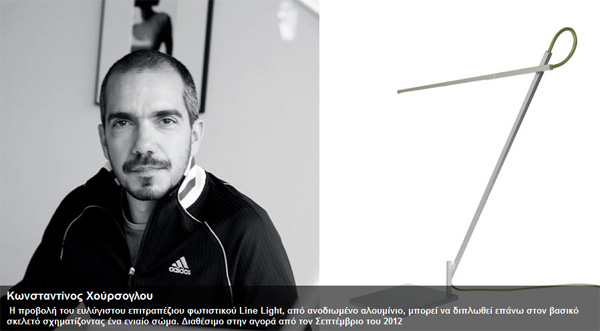
Konstantinos Choursoglou
• A rich CV with plenty of highlights, among them a two-year stint as design director at Karim Rashid’s studio, the design of the podiums for the Athens Olympics and Paralympics, and being named a “Walker of Tomorrow” by Johnnie Walker in 2006.
• His studio, Chd, was founded in 2002, and five years later its base moved to Geneva, where it remains today.
• “Abroad there are more opportunities, but the competition is tougher. Creativity can shine wherever you are, as long as it isn’t besieged by routine and complaining.”
• If you happened to walk through the Ecomuseum space in Syntagma last year, as part of the Green Design Festival, it is worth knowing that Konstantinos designed it.
• “Trends are for the uncreative. ‘Design for life, not magazine covers,’ as Jasper Morrison famously put it.”
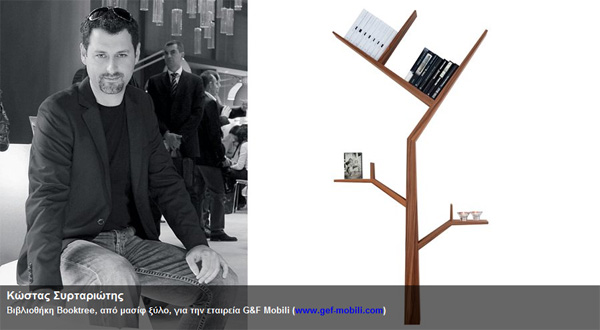
Kostas Syrtariotis
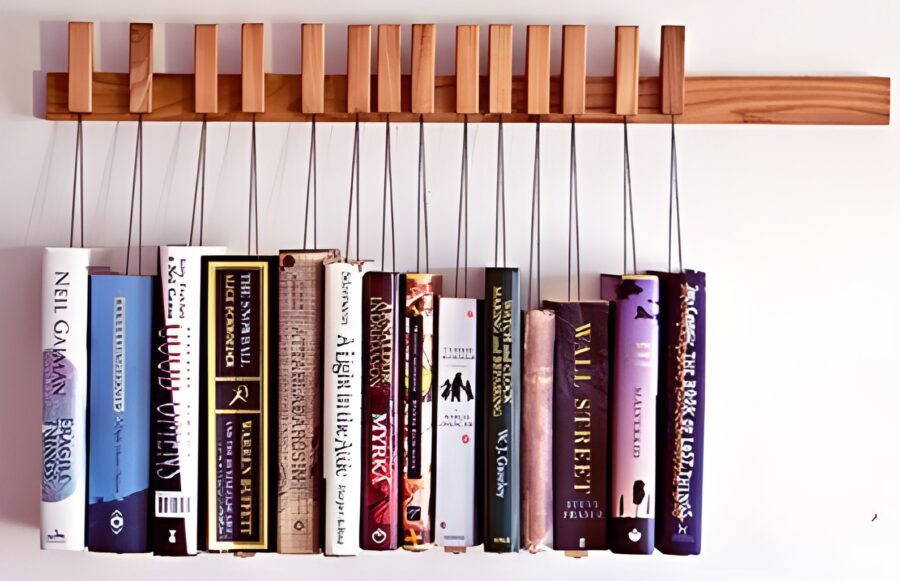
• He made a splash at Euroluce 2009 in Milan with the Sit-up floor lamp, which took two years of research and experimentation. This year he returned to the same event, the greatest celebration of design, with the Booktree bookcase.
• Until 1993, when he graduated from the Plaka Arts Centre, he stayed on Greek soil. Then Venice beguiled him. He went there to study at Iuav University and in 2003 founded his own studio there. “Things somehow came about on their own: friendships, first professional steps, family. Besides, the heart of world design still beats in Italy.”
• As he himself admits, his career so far has taught him that “he who persists wins”!
• His approach to design is experimental, “probably because I was good at chemistry.” He follows no style, only sparks that develop and end up as a product, a prototype or a work of art.
• “I think the role of design today, like that of art, is to give us occasions for dialogue, to shake us up and wake us up, if need be.”
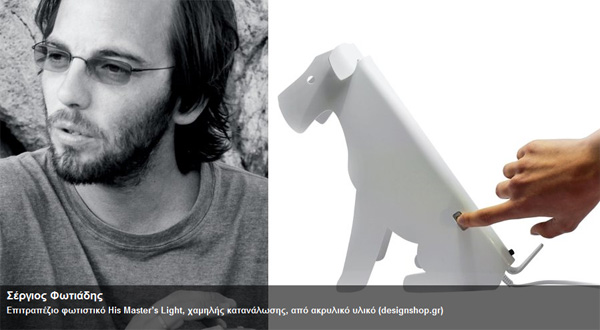
Sergios Fotiadis
• He has a particular soft spot for toys. In 1996 he stood out by designing, in just six weeks, the first children’s sled for the American company Rubbermaid. In 2006 he designed a series of Plexiglas animals, which were sold at the Benaki Museum shop, and at this year’s Green Design Festival he returned with Aurora Craft: a recyclable cardboard house.
• Together with graphic designer Theano Petridou and his brother Filippos, an architect, he founded the creative studio W/E design in 2001.
• Since 2005 he has taught in the Department of Product and Systems Design Engineering at the University of the Aegean. He himself studied industrial design at the Rhode Island School of Design in the US.
• His favourite material is acrylic, whose qualities he exploits to the full, creating everything from rings to lamps.
• “The design of a product is considered successful only when it meets the needs of the use for which it is intended. Good design is not necessarily expensive. It takes experience, research and good collaborators to bring a competitive Greek product to market.”

Alexandros Didaskalou
• He doesn’t dwell on views about “greater difficulties in Greece” and prefers to deal realistically with whatever reality he faces. “I’m sure that all the people we admire and envy worked just as hard, if not harder, to stand out in the face of very real competition.”
• The start of his career is officially placed in 1998, with the founding of the design office fortywaves. In 2007 he went on to co-found and run the company edg designlab, with the aim of creating innovative ideas through functional objects and systems. “Investing in design is investing in the product itself, in its everyday value.”
• “What is timely is whatever is successfully tested through a change in circumstances and proves the creator’s apt vision and approach.”
• At the Royal College of Art in London, where he earned a Master of Arts in Design Products, he studied under Ron Arad. “There I learned that if you’re worth it, you win. He got bored easily, but if something interested him, his eyes lit up.”
• For Alexandros, what matters is people, and every creation of his aims to meet real needs. “This year I was at a beach in Halkidiki. The wind was incredible. It had blown over all the umbrellas. The Kite beach shade we designed for Terra stayed rock solid. That’s the satisfaction for me. The best reward.”

Aliki Rovithi, Foad Ashour
• As they joke themselves, when Aliki was finishing high school, Foad was playing on the swings. Life brought them together when they found themselves classmates at the Akto school and later colleagues at a design studio. Dede was founded in 2007.
• “Innovation, humour and a conceptual approach, which can’t be copied, can make the difference. We’re interested in creating a meaningful relationship between the object and the user.”
• They were the only Greek entry at Salone Satellite 2010, at Milan’s major design gathering.
• In the end, 2010 proved to be their year: they won the international Red Dot Award in the Design Concept 2010 category for the This Side Up coffee table, and first prize in the Platinum A’ Design Award for the Get the Hang of It paper bag with built-in hangers.
• “Good collaboration doesn’t come from total agreement. We are two different people who respect each other but also see things differently. That’s what makes us grow.”

Giannis Gkikas
• A practical spirit, he puts people at the top of design’s priorities. “I try to design functional things without neglecting their aesthetics.”
• The Monarchy stool, always in motion yet perfectly balanced and reminiscent of an upside-down crown, won a Red Dot Design Award in 2010 in the Design Concept category. “I find that part of design which concerns the idea hidden behind every object extremely fascinating.”
• “I don’t think I’ve managed to approach a major company successfully. Living in Athens, it’s practically impossible to meet people in person or become part of a design scene, which would help considerably in that direction.”
• After “getting acquainted” with Giannis’s work, one could conclude that clean forms arising from clean lines are his characteristic creative signature.
• “I don’t want to approach design, at least consciously, as a trend or a fashion I must follow. In practice that may happen in the end, but I want to start with a mind as clear as possible.”
Text: Ioanna Zymariti
Source: tovima.gr